
Cyprus permanent residency
Updated:
Cyprus permanent residency is the right of a non-EU national to live in Cyprus with no end date. Its legal name is the Immigration Permit. The right does not expire, but the card that proves it runs ten years and is then replaced. The permit can be lost, for example after two years spent outside Cyprus.
A non-EU national becomes a permanent resident of Cyprus by investing at least €300,000 under the fast-track procedure, or by showing a secured income from abroad under Category F. After five years of legal residence on another permit, a non-EU national can apply for long-term resident status instead. EU citizens and their family members acquire permanent residence after five years under the EU free movement rules.
Marriage to a Cypriot does not lead to permanent residence. It gives a renewable residence permit, and the stay has no time limit for as long as the conditions are met.
On the investment route the Migration Department puts the examination at about two months from the date a complete application is submitted. In practice it takes about six months. The permit covers the investor's spouse and children under 18.
A permit holder can apply for citizenship after eight years of legal residence: seven years within the ten years before the final twelve months, plus those twelve months of continuous residence. The applicant needs Greek at B1 and a pass in the state examination on the political and social life of Cyprus.
Contents ˅
- Permanent residence programs
- Benefits of Cyprus permanent residency
- Fast-track procedure for obtaining a PR
- Cyprus permanent residency cost and government fees
- Residence on a secured income from abroad
- Long-term resident status and residence by marriage
- Permanent residence for EU citizens and their families
- Conditions and restrictions of the permanent residency program
- How to get permanent residency in Cyprus
- Permanent residency or citizenship?
- FAQ
Permanent residence programs
A PR in Cyprus is divided into several main categories.
Permanent residency by investment
The fast-track pathway under Regulation 6(2) requires an investment of at least €300,000 in a new home (plus VAT), other real estate, the share capital of a Cyprus company or units of a Cyprus investment fund. On top of the investment, the applicant shows a secured annual income of at least €50,000 before tax.
The residency-by-investment permit through property purchase is the most straightforward option for investors. More details and requirements below.
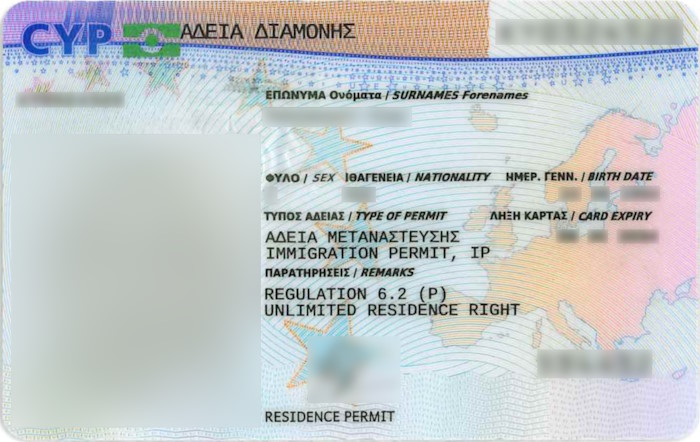
Here is an example of the Cyprus permanent resident card obtained through investment:
Residence on income from abroad
Permanent residency Category F requires an annual income from abroad to cover living expenses while residing in Cyprus, without working or doing business. The required yearly income starts from €9,568 for one applicant plus €4,613 for each dependent person.
Residency with the right to work
Regulation 5 sets six categories of Immigration Permit, A to F, and the first five are for people who work in Cyprus. Category C is for a self-employed person in a trade or profession who holds the relevant licence and has about €260,000 freely at their disposal. Category E is for a person offered permanent employment in Cyprus that will not create undue local competition. Our page on the Cyprus business visa covers both.
In our practice, companies now bring non-EU staff in on a work permit through the Business Facilitation Unit rather than under Categories C or E.
Benefits of Cyprus permanent residency
The benefits of Cyprus permanent residency are a right of residence with no end date, cover for the spouse and children under 18, a route to citizenship after the qualifying period, and access to the General Healthcare System for those who live here.
The list of benefits includes:
- The right of residence has no end date, as long as you keep to the conditions.
- The permit covers your spouse and your children under 18.
- After eight years of legal residence (seven years within the ten years before the final twelve months, plus those twelve months), a permanent resident can apply for citizenship by naturalisation on form M127. Greek at B1 and a pass in the civics examination are part of the test.
- On the fast-track route the Migration Department estimates about two months for the examination. In practice the card takes about six months.
- A permanent residence permit does not make you a Cyprus tax resident. Tax residence follows the time you spend in Cyprus and your ties here. A tax resident who is not domiciled in Cyprus pays no special defence contribution on dividends and interest.
- A permanent resident who is an ordinary resident of the government-controlled areas is a beneficiary of the General Healthcare System (GeSY). An investor whose main home stays abroad is outside it and keeps private health insurance.
Fast-track procedure for obtaining a PR
Changes announced in September 2026
On 24 September 2026 the Deputy Minister of Migration and International Protection told the House Audit Committee that decisions on tightening the investor permit scheme are expected. About 12,000 permits issued since 2013 are under review to check that their holders still meet the conditions. No new rules have been published. Until they are, the criteria on this page apply.
Requirements for Cyprus permanent residency by investment
To qualify for Cyprus residency, investors must follow certain criteria.
- For residential properties, the investor must purchase a new house or apartment (or two properties) from a development company, for a minimum of €300,000 plus VAT.
- For commercial properties, the investor must purchase offices, hotel buildings, shops, or other commercial real estate worth at least €300,000. The property can even be a resale.
- The sale contract must be filed at the Department of Lands and Surveys, and the payment receipts must reach at least €300,000, not counting VAT. The money is paid into the seller's account at a Cyprus bank. It must come from abroad, from the couple's own accounts or from a company they wholly own, and not from a loan taken out in Cyprus.
- The delivery date does not matter, so properties under construction can be included.
- The property can be bought in the name of a company whose absolute owner or ultimate beneficiary will be the investor or his/her spouse.
The standard VAT rate is 19%. A 5% reduced rate applies to the first 130 square meters of a primary residence, up to €350,000 of its value, provided the total transaction value is below €475,000, and the total buildable area is under 190 square meters. A property over €475,000 or over 190 square meters is taxed at 19% in full.
The reduced rate is for a buyer who lives in the home as their main residence for ten years, so an investor who keeps a main home abroad pays 19%.
If you're an investor looking to obtain permanent residency in Cyprus through means other than real estate investment, you have two options available (same amount of €300,000):
- You can invest €300,000 in the share capital of a newly registered Cyprus company, or in an increase of the share capital of an existing one. The company must be based and operating in the Republic, with a proven physical presence and at least five employees.
- You can invest €300,000 in units of a Cyprus collective investment fund set up under CySEC supervision, such as an AIF or a RAIF. The fund's own investments have to be held in the Republic of Cyprus.
If the investor wishes to sell the investment or the property, he/she must replace it with another of equal or greater value and follow all the above-mentioned conditions.
Annual income
The investor must show a secured annual income of at least €50,000 before tax. It rises by €15,000 for the spouse and €10,000 for each dependent child under 18.
On the new-home route the income has to come from abroad, proved by a tax return from the country where you are tax resident or by a certificate from an independent certified accountant. On the other routes part of it may come from activity in Cyprus.
It can be any source of income, including salaries, pensions, dividends, fixed deposits, and rents. The spouse's income (if any) can be included in calculating income.
Family members
The permanent residency permit covers the spouse and children up to 18 years old.
Children aged 18 to 25 are not covered by the parent's permit. They can file their own Immigration Permit application, with its own fee, if they meet these conditions:
- Financially dependent on the investor.
- Unmarried.
- Students of tertiary education abroad on the date the application is submitted.
- The parents have an additional annual income of €10,000 for each child.
Children retain their permanent residency status, even if they are over 25 or no longer fulfil the above criteria (unmarried, financially dependent, students).
Their future spouse or children cannot be added as dependants on that permit, and it is cancelled if the parent's permit is cancelled.
A child who wants to study at a university or college in Cyprus applies through it for a temporary student residence permit. After graduating, at any age, the child can apply for their own Immigration Permit, with the parents showing an additional annual income of €10,000.
Adult children
The "adult children" are the applicant's children who are not financially dependent.
For a non-financially dependent adult child to apply under the same investment, the applicant must meet the higher-value investment criteria. The standard €300,000 investment value must be multiplied by the number of adult children applying.
Example investment calculations:
- Example 1: An applicant with one adult child must invest €600,000.
- Example 2: An applicant with two adult children must invest €900,000.
For adult children applying based on their parents' real estate investments, a payment certificate showing at least 66% of the property's market value must be submitted with the application documents.
Each adult child files a separate application and must individually demonstrate that they have an annual income of at least €50,000. This amount increases if they have dependents (by €15,000 for a spouse and €10,000 for each child).
Other conditions
Applicants must also comply with the following:
- The applicant and spouse provide a clean criminal record certificate from their country of origin and from their country of residence, where the two differ. After approval, the applicant and adult family members provide new certificates every three years.
- They should not be regarded as a danger to the public order/security of Cyprus.
- The applicant and dependants hold health insurance covering inpatient and outpatient care.
- The applicant and spouse confirm in writing that they will not take employment in Cyprus, except as directors of a company they invested in.
The legal basis of the permanent residence scheme is Regulations 5 and 6(2) of the Aliens and Immigration Regulations. The Migration Department publishes the criteria for investors now in force.
Cyprus permanent residency cost and government fees
The main cost of the fast-track route is the €300,000 investment plus VAT on new property. On top of that, the government charges the fees below, and legal and translation fees apply separately.
Government fees:
| Applicant / applicants' spouse / children under 18 | €500 for all €70 for each person for registration |
| Adult children (each) | €500 €70 for registration |
The fees are the same for Category F permits.
Residence on a secured income from abroad
To be eligible for a Category F permit, the slower route to permanent residency, the applicant mainly needs to show:
- Property purchase
Cyprus permanent residency category F laws are flexible and do not require property purchase. But it is recommended that you buy a property in Cyprus for any amount. It can even be a resale property. The money for the purchase does not need to be transferred from abroad.
- Annual income
The applicant must show a secured yearly income from abroad of at least €9,568, plus €4,613 for each dependent person. It can be pensions, dividends, interest on fixed deposits, rents and similar income.
The amounts specified as requirements are insufficient in practice for living in Cyprus, as the cost of living is higher.
- Bank account in Cyprus
The application includes original statements of the applicant's bank account in Cyprus, so the account has to be open before you apply. The department's document list names no minimum balance.
- Family members
Only children up to 18 can apply as dependents, and their permanent residency will remain valid until they turn 18. The applicants' parents cannot apply as dependents.
Applying for the PR category F with a rented property is also possible. However, the Migration Department may decline the application. Based on our experience, we recommend applying after purchasing a property.
Filing a Category F application gives no right to stay in Cyprus. For as long as it is pending, you need a valid temporary residence permit or visa.
Long-term resident status and residence by marriage
Permanent residence after 5 years of stay
Non-EU nationals who have lived in Cyprus legally and continuously for the five years before applying, and hold a valid residence permit, can apply for long-term resident status. Absences shorter than six consecutive months, and no longer than ten months in total, do not break the five years. Students are outside this route.
The status is permanent, but it has conditions of its own: Greek at A2, the civics certificate, health insurance and stable income.
Residence by marriage to a Cypriot
A non-EU spouse or civil partner of a Cypriot citizen gets a renewable residence permit, not permanent residence. The stay has no time limit, as long as the conditions are met and the permit is kept valid.
Children under 21, or older children dependent on the Cypriot citizen, qualify on the same basis. So do the dependent parents of either spouse and the non-EU parent of a minor Cypriot child. Our page on residence by marriage to a Cypriot sets out the forms and documents.
Permanent residence for EU citizens and their families
EU citizens need no permit for the first three months in Cyprus. To stay longer, they apply for a registration certificate, the Yellow Slip (form MEU1), within four months of arriving.
After five years of continuous legal residence, an EU citizen acquires the right of permanent residence and can apply for a certificate on form MEU3. The investment and income figures of the Immigration Permit do not apply.
A family member from outside the EU who has lived in Cyprus for the same five years applies for a permanent residence card on the MEU3 form for third-country nationals. The fee is €20 and the decision comes within six months. The card is valid for ten years and is renewed on application.
UK nationals covered by the Withdrawal Agreement, and their family members, have a separate permanent residence document, issued on form UKW3.
Conditions and restrictions of the permanent residency program
- An investment permit holder and spouse may not take employment in Cyprus, except as directors of the company they invested in. They may hold shares in other Cyprus companies and take dividends from them, and they may sit on those boards as unpaid directors. A Category F holder may not work or run a business in Cyprus.
- The Cypriot permanent residence permit gives no visa-free travel to other European Union member states or the Schengen area. A few countries outside the EU accept it, Serbia and Albania among them.
The right of residence has no end date. The card that proves it expires ten years after issue and has to be replaced. A permit issued to a child under 18 as a dependant is valid until the child turns 18, on the investment route and under Category F alike.
Two years outside Cyprus ends the permit
An Immigration Permit ends if the holder is absent from Cyprus for two years. The rule applies to the holder and to the dependants on the permit.
The permit ends in four other cases as well:
- The holder acquires permanent residence in another country.
- A holder who lived abroad when the permit was approved does not take up residence in Cyprus within one year of the approval.
- An investor sells the investment without replacing it at once with one of equal or greater value.
- An investor fails the yearly or three-yearly checks set out below.
Annual obligations to verify criteria
The applicant must submit to the Migration Department a confirmation that they retain the following.
Submitted every year (annually):
- The initial investment.
- Health insurance, in case the applicant and their family are not covered by the General Health System (GeSY).
Submitted every three years:
- A clean criminal record in their country of residence and their country of origin.
The residence permit will be withdrawn if these documents are not submitted or verified.
The requirement to submit proof of income annually has been abolished.
How to get permanent residency in Cyprus
The investment permit and the Category F permit are both Immigration Permits. You apply for either one on form MIP2 at the Migration Department in Nicosia, with the documents listed below. The investment route is the fast track: about two months by the department's estimate, about six months in practice.
Long-term resident status and the EU routes use their own forms, which the pages linked in the sections above set out.
Required documents
To obtain a permanent residency permit in Cyprus, an applicant must submit the following required documents. Each route has its own list.
Investment route
- Application form MIP2, from the Migration Department forms page (the current version is a Word file dated 9 March 2026), duly completed.
- Copy of a valid passport of the applicant, spouse and children.
- Curriculum Vitae for the applicant.
- Marriage Certificate duly certified (official and certified translation).
- Children's Birth Certificates duly certified (official and certified translation).
- Original criminal record certificate for the applicant and the spouse, from the country of origin and from the country of residence where they differ, with an official certified translation. For UK citizens, it must be from the ACRO Criminal Records Office (not the DBS).
- Health insurance certificate covering inpatient and outpatient care for the applicant and dependants.
- Title of ownership, or the contract of sale filed at the Department of Lands and Surveys, with payment receipts of at least €300,000 excluding VAT.
- Bank Swift for the payment of the purchase price & receipts of payment, showing that the money came from abroad.
- A recent search certificate from the Department of Lands and Surveys, where the contract or the title deed is more than a year old.
- Proof of annual income: a tax return from the country where you are tax resident, or a certificate from an independent certified accountant, with an affidavit on the income.
- A statement from the applicant and spouse that they will not take employment in Cyprus, except as directors of a company they invested in.
- Where a child under 18 is included and both parents are not applying, a consent declaration from the other parent signed before a Cypriot consular officer.
Category F
- Application form MIP2, duly completed.
- Copy of a valid passport of the applicant and dependants.
- Copy of a valid temporary residence permit, if the applicant already lives in Cyprus.
- Original statements of your bank accounts in the Republic of Cyprus.
- A declaration of secured annual income, with the original documents and an affidavit.
- Title of ownership or contract of sale with proof of payment, or a rental agreement.
- Original criminal record certificate for the applicant and the spouse, with an official certified translation. An applicant living abroad gets it from the country of residence.
- Marriage certificate and children's birth certificates, duly certified and officially translated.
- For applications filed from 1 September 2026: original blood test results taken abroad showing that the applicant and each dependant are free of hepatitis B, hepatitis C, HIV and syphilis, and an original chest X-ray for tuberculosis from the country of origin or the last country of lawful residence. Both are certified or legalised, except where a bilateral agreement removes that step.
A holder of a Cyprus temporary residence permit whose earlier medical test results are still on file does not repeat them.
Please note that Criminal Record certificates, marriage certificates, and children's birth certificates should be translated into English and certified by the Ministry of Foreign Affairs (or Embassy) of the country that will issue them. This can be done by the Cyprus Embassy of that country or by bearing the APOSTILLE stamp.
Application procedure
The application for permanent residency can be submitted by the investor's lawyer; the applicant does not need to be present at the time of submission. Applications are only provided at the Migration Department in Nicosia, not at the district immigration units of each city.
Your photograph and fingerprints are taken for the card when the application is filed or at any point after it, at the Migration Department in Nicosia or at the Aliens and Immigration Unit of the Police in the district where you live. A child under six gives only a photograph.
The district units are at these addresses.
| Nicosia | Agamemnonos 6, Engomi, 2411 Nicosia |
| Limassol | Franglinou Rousvelt 223, Zakaki, Building "D. Nikolaou", 2nd floor, 3046 Limassol |
| Larnaka | Tasos Mitsopoulos 34, 6027 Larnaka |
| Pafos | Eleftheriou Venizelou & Kaningos 22, 2nd floor, 8021 Pafos |
| Famagusta | Giorki Papadopoulou 31, 5282 Paralimni |
On approval, the lawyer will collect the PR cards.
Processing time
On the fast-track route the Migration Department estimates the examination period at about two months from the date a complete application is submitted. In practice it takes about six months. Once approved, the lawyer can collect the cards on behalf of the investors.
The Migration Department publishes no target examination time for a Category F application. Applications are filed as usual.
Permanent residency or citizenship?
Citizenship gives the vote and the right to live and work anywhere in the EU. Permanent residence gives the right to live in Cyprus, and it ends after two years outside the country.
The bridge between the two is eight years of legal residence and Greek at B1. Our comparison of Cyprus residency and citizenship sets the two side by side.
Frequently asked questions
How much does Cyprus permanent residency cost?
The fast-track route needs a €300,000 investment plus VAT on new property. Government fees are €500 for the main application, which covers the spouse and minor children, with €70 per person for registration. Each adult child applying separately pays €500 plus €70. Category F carries the same government fees and a lower income threshold, but no €300,000 investment. Legal and translation fees apply on top.
Can I get permanent residency by buying a house in Cyprus?
Yes. Buying a new property worth at least €300,000 plus VAT, together with secured income from abroad of €50,000 (plus €15,000 for a spouse and €10,000 per child under 18), qualifies you for the fast-track permit. The Category F route sets no minimum property value and requires income of €9,568 plus €4,613 per dependent, though buying or renting a home in Cyprus is still expected.
What is the difference between permanent residency in Cyprus for non-EU and EU citizens?
EU citizens do not need a permit. One staying longer than three months applies for a registration certificate, the Yellow Slip, within four months of arriving. After five years of continuous legal residence, EU citizens acquire permanent residence and can apply for a certificate on form MEU3. Non-EU family members get a permanent residence card after the same five years. Other non-EU nationals need an Immigration Permit or, after five years of residence, long-term resident status.
How to get Cyprus PR for Indians?
Indian citizens follow the same routes as other non-EU nationals. Most choose the fast-track investment route, which requires a €300,000 investment, usually a new home bought from a developer plus VAT, and proof of income secured from abroad. The Migration Department estimates about two months for the examination, and in practice it takes about six.
The Category F route suits applicants with steady foreign income who do not want to invest €300,000. We handle the application and document legalisation from India on your behalf.
Can a student get permanent residence in Cyprus?
Not as a student. A student residence permit is temporary and does not by itself lead to permanent residence. A child of an investment permit holder who studies in Cyprus can apply for their own Immigration Permit after graduating, with the parents showing an extra €10,000 of annual income. Anyone else applies under one of the routes on this page on its own terms.
Can I lose Cyprus permanent residency?
Yes. An Immigration Permit ends if the holder is absent from Cyprus for two years or acquires permanent residence in another country. It ends too if a holder living abroad at approval does not take up residence in Cyprus within a year. An investor loses it by selling the investment without replacing it, or by failing the yearly and three-yearly checks.
Does marriage to a Cypriot give permanent residency?
No. The non-EU spouse or civil partner of a Cypriot citizen gets a renewable residence permit, not permanent residence. The stay has no time limit as long as the conditions are met and the permit is renewed on time. Our page on residence by marriage to a Cypriot covers the forms and documents.
Can I work in Cyprus with permanent residency?
That differs by permit. An investor and spouse may not take employment in Cyprus, except as directors of the company they invested in. A Category F holder may not work at all. Categories A to E are permits for people who work in Cyprus. If you want to work here, look at a work permit or, for highly qualified staff, the EU Blue Card.
Do I need to speak Greek for Cyprus permanent residency?
Not for an Immigration Permit: neither the investment route nor Category F sets a language test. Long-term resident status needs Greek at A2 and a certificate on the political and social reality of Cyprus. Citizenship needs Greek at B1 and a pass in the civics examination.