
Cyprus Pink Slip: the temporary residence permit for non-EU nationals
Updated:
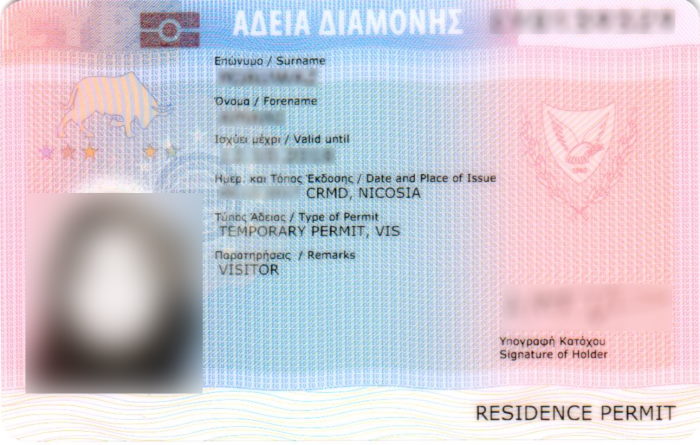
The Cyprus temporary residence permit, also known as the Pink Slip, Pink Card, or TRC card (Temporary Residence Card), allows non-EU passport holders to extend their stay in Cyprus beyond a 90-day visa period without the right to work. The residence permit is valid for 1 year and can be renewed annually.
The main rules are:
- The applicants' family members (spouse and children under 18) can obtain the same Cyprus residence permit as dependents.
- Applicants must show sufficient annual foreign income (at least €24,000) to cover living expenses in Cyprus to be eligible to apply for a temporary residence permit.
- The application is submitted in the district where they live in Cyprus, and the Migration Department examines it.
- A Pink Slip is a temporary status that is renewed each year. For permanent residence, see Cyprus permanent residency.
Pink Slip, Pink Card, TRC card and Temporary Residence Card are common names for the visitor's temporary residence permit that the Migration Department issues to third-country nationals. The department's own term is visitor's residence permit.
Contents ˅
Cyprus temporary residence permit overview
With a temporary residence permit, a person may reside in Cyprus as a visitor without the right to work. Family members, spouse, and children (under 18 years old) can receive the pink slip as dependents.
The whole family applies simultaneously; each member files a separate application form and gets his/her temporary residence card.
Pink Slip restrictions
- Do not stay outside Cyprus for more than three months at a time. If you leave and do not return within three months of the date you left, the permit is cancelled, regardless of the validity period printed on it. You then follow the entry procedure for your purpose of stay. Within three months, you can re-enter on the permit and a valid passport.
- No right to work in Cyprus.
- It is granted only to non-EU Nationals who wish to extend their stay in Cyprus.
How long is a Pink Slip valid for?
A first Pink Slip is valid for one year and is renewable, provided the applicant continues to meet the requirements. In our experience, the one-year period starts from the date of approval, not the date of application submission.
If the applicant's passport expires sooner, the residence permit validity will be set to end three months before that date.
Pink Slip or Yellow Slip?
A Pink Slip is for nationals of countries outside the EU. EU/EEA citizens register for a Yellow Slip instead. That certificate has no expiry date and comes with the right to work. A Pink Slip runs one year at a time and allows no employment.
How to check your Pink Slip (TRC card) status
To check your Pink Slip status, send an SMS to 1199. Write it exactly as STATUS, one space, then the application number, for example STATUS 1243/2026. Each message costs under €0.04.
The application number sits on the receipt you were given when you paid the application submission fee, on form Γ.Λ. 301B.
Check Pink Slip status online
The Migration Department publishes the SMS service above for status checks. Applicants whose lawyer filed the application can request an update through the lawyer.
How to obtain a Cyprus Pink Slip
- Enter Cyprus on a valid entry visa (or visa-free for eligible passports) and keep the arrival stamp.
- Outside the Nicosia district, book the appointment by email with the district unit of the Aliens and Immigration Service of the Police, at least one month before your current permit or visa expires. The answer comes within five working days. In the Nicosia district, a visitor permit application needs no appointment.
- Rent or buy accommodation, and have the rental agreement duly certified. In practice it is certified by the Muhtar, the local community leader who certifies documents. A host declaration works in its place if you are staying with someone.
- Open a Cyprus bank account and receive foreign remittances in your own name: at least €2,000 a month or €24,000 a year for one person, increased by 20% for a spouse and 15% for each child. For a first permit, a cash transfer or deposit of at least €10,000 is accepted as well.
- Set up the required bank guarantee, valid for at least ten years. The amount follows your country of origin, and the Migration Department publishes it.
- Obtain a health insurance certificate and complete the medical exams in Cyprus.
- Prepare all required documents (see details below) with apostille and translation where required.
- Attend in person to submit the application and give biometrics. You pay a €70 application fee and, for a first permit only, a €70 registration fee.
- Wait for the decision. The department's stated timetable is usually before four months have passed, provided the documents you filed are sufficient, and we see closer to six in practice. Until the application is examined, you will not face problems with the Police, and in an inspection you can show proof of submission.
Pink Slip requirements
To be eligible for a Pink Slip, the applicant is required to show:
- adequate annual income from abroad, transferred to a Cyprus bank account, starting at €24,000 for a single applicant and increased by 20% for a spouse and 15% per child (see detailed amounts below),
- accommodation in Cyprus, rented or bought, or a host declaration from whoever is putting you up,
- health insurance,
- medical exams,
- bank guarantee.
Necessary documents
To obtain a temporary residency permit in Cyprus, the applicant needs to apply with the following required documents. The list continues below in groups, starting with the application form and the rental or sale agreement:
- Form MVIS8, the visitor application, one for each family member.
Download the current version from the Migration Department forms page rather than from any copy elsewhere.
- Rental agreement or sale agreement of a house/apartment
Bring the original rental agreement, duly certified, with a copy. At renewal the copy is enough. A title deed or purchase document deposited in the land registry works in its place. The department's list names no minimum term for the rental, though in our experience a one-year agreement matches the permit and avoids questions.
No stamp duty is payable on a rental agreement signed on or after 1 January 2026. For an agreement signed before 2026, the duty due under the old rules is paid to the Tax Department before you file.
The department's list for visitor permits still reads "stamped, where applicable" next to the rental agreement. That wording is the old stamp duty. For agreements signed on or after January 1, 2026, no stamp duty is payable. For agreements signed before 2026, the correct duty is paid to the Tax Department before registration.
If you are staying with someone rather than renting, a host declaration for the provision of suitable accommodation is accepted instead.
Bank statement
The bank statement must meet these requirements:
- Bank statement and proof of transfer from abroad
The bank statement covers the last 12 months for a renewal, or the period since you opened the account for a first permit. It must show foreign remittances in the applicant's own name of at least €2,000 a month or €24,000 a year for one person. Transfers abroad or to third parties are not counted.
For a first permit, a cash transfer or deposit of at least €10,000 is accepted as well. For a renewal, the balance in the account must be at least €6,000, whatever the size of the family. For a dependent spouse or child, the statement is the supporting spouse's or parent's.
In the case of a cash deposit, the cash declaration at customs must be submitted. (Learn how to open a bank account in Cyprus).
The bank statement comes with a declaration of the number of family members you will support in Cyprus and a summarised statement of income.
This required annual amount is increased by 20% for the spouse and 15% for each child.
Bank guarantee for each family member
Each family member needs a bank guarantee:
- Bank guarantee
Set up a bank guarantee at a bank in Cyprus, one for each family member, valid for at least ten years. It covers possible repatriation costs. A spouse or child applying as a dependent has the guarantee drawn on the account of the supporting spouse or parent.
At renewal, a new guarantee is not needed if the one already lodged is still valid, is not close to its expiry and covers the requested stay plus one year. Amounts by country of origin:
- €350: Afghanistan, Bahrain, Egypt, Iran, Iraq, Israel, Jordan, Kuwait, Lebanon, Oman, Palestine, Qatar, Saudi Arabia, Syria, Turkey, the United Arab Emirates and Yemen.
- €550: Albania, Andorra, Belarus, Bosnia and Herzegovina, the Faroe Islands, Gibraltar, Moldova, Monaco, Montenegro, North Macedonia, Russia, San Marino, Serbia and Ukraine.
- €850: all other countries with an amount shown, including Georgia, Armenia, Azerbaijan and Kazakhstan, the United States, Canada, Australia, New Zealand, India, China, Thailand, Singapore, Brazil, Nigeria, South Africa and the rest of Africa apart from Egypt.
- No amount shown: the EU and EEA states, Switzerland, the United Kingdom, Cyprus and the Vatican City State.
The amounts follow the cost of returning the applicant to the country of origin. Nationals of the EU and EEA states, Switzerland, the United Kingdom, Cyprus and the Vatican City State have no amount set against their country in the table. The table does not say whether a guarantee is waived for them, so confirm before you rely on it.
Check the current table for your country before you apply. In our experience, the bank takes 7 business days to issue the guarantee.
Health insurance and medical exams
Two health documents are required:
- Health insurance
The Migration Department asks for a certificate covering inpatient and outpatient care and transportation of remains, which its document list calls Plan A.
An existing international policy works, or you can buy cover in Cyprus, usually issued the same day. Cover at that level runs around €175 a person on the policies we see, though the figure moves with age and insurer.
A visitor permit does not make you a GHS (GeSY) beneficiary. For a third-country national, the Health Insurance Organisation lists five routes: employment, permanent residence status, refugee or supplementary protection status, being a family member of a beneficiary, and being insured in another EU Member State.
- Medical exams (needed only for the first permit, not for the renewals)
They are done in Cyprus, and they are blood tests showing that the applicant does not suffer from the following:
- Hepatitis B and C, HIV, and syphilis
- A chest X-ray report for tuberculosis
The results go with the doctor's opinion, sealed by a specialist doctor from the Republic of Cyprus. The department's list sets no validity period for the results, so book the tests close to your appointment date.
For a child, the blood tests can come from the country of origin or residence. A child under 15 has a Mantoux skin test instead of the chest X-ray, and a child under 6 who was born in Cyprus needs no medical examination.
Any private clinic or hospital in Cyprus can do these tests. These are the ones our clients use most:
- Limassol: Ygia polyclinic
- Paphos: Evangelismos private hospital
- Nicosia: Aretaeio private hospital
Proof of income
Which income the department accepts, and how much:
- Documents to prove income from abroad
The department accepts salary, a pension, deposits in a bank account abroad, rents, dividends and interest on deposits as income from outside Cyprus. By exception, it accepts rents in Cyprus and income in the Cyprus account from a salary for earlier work in a company of foreign interests. It accepts dividends from a Cyprus company only with the company accountant's certification that the applicant draws no salary from it.
Annual foreign remittances needed:
- €24,000 for a single applicant (to have an extra 20% for the spouse and 15% for each child)
- €28,800 for a couple
- €32,400 for couple and 1 child
- €36,000 for a couple and 2 children
Passport and other personal documents
The remaining documents are:
- Copy of a valid passport or other travel document, valid for at least three months beyond the stay you ask for, and a copy of the page that shows your last arrival in Cyprus and the entry visa, where one applies.
- Marriage Certificate duly certified and translated *(If applicable)
- Children's Birth Certificates, duly certified and translated *(If applicable)
- Proof of attendance or enrolment in an educational institution in Cyprus, for a child who is a student
- For a child, where applicable: a certified and translated copy of a court decision on sole parental care or guardianship, or the sworn consent of the other parent to the child's residence in Cyprus for the proposed stay, where that parent was in Cyprus and has left. If the other parent is abroad, a certification from the embassy or consulate of Cyprus there is accepted.
- For a dependent spouse or child: a duly certified declaration of assumption of expenses and accommodation by the supporting spouse.
- Criminal record certificate from the country of origin, or from the country of residence if the applicant lives in a different country * (first permit only). In our experience, it should be no older than 6 months. For UK citizens, it must be from the ACRO Criminal Records Office, not the DBS.
Translation and certification of documents
The documents marked * must be in Greek or English, or come with an official translation by a sworn translator, a consular authority or a government department of the issuing country.
Certification follows the type of document:
- A public document from a country that is party to the Hague Apostille Convention carries an Apostille.
- A public document from any other country carries diplomatic certification.
- A public document issued by an EU Member State authority, such as a birth or marriage certificate, is exempt from authentication and Apostille under Regulation (EU) 2016/1191. A criminal record certificate falls under it only when it is issued to a citizen of the Union by the authorities of that citizen's own Member State, so a non-EU applicant's police certificate still needs an Apostille or diplomatic certification.
- A non-public document is certified by a certifying authority of the issuing state.
Documents issued by Russia or Serbia need no certification or Apostille if they are properly signed and bear the official seal of the authority that issued them. They still need to be in Greek or English, or come with an official translation, and in our experience the translation can be completed in Cyprus.
Cyprus Pink Slip processing time in 2026
The Migration Department states that a visitor application is normally examined within four months, provided the documents filed with it are sufficient. Six is closer to what we see in practice, and a file that needs a document re-submitted or translated again runs longer still.
The Migration Department confirms that you will not have problems with the Police during that period, and that you can show proof of submission of your application if you are checked. That protection does not extend to immigration permits or long-term resident status.
If you must travel before the permit is issued, check whether the payment receipt for your application carries the department's stamp allowing re-entry into Cyprus. If it does, show the receipt with your passport on return. If it does not, apply to the department for a re-entry permit, which as a rule is granted only for serious reasons such as health.
Application submission location
The applicant must apply in the district where they live. Outside the Nicosia district, the appointment is arranged with the District Unit of the Aliens and Immigration Service of the Police, by email.
In the Nicosia district, you deal with the Migration Department directly, at 90 Archbishop Makarios III Avenue, 1077 Nicosia, telephone 22308808. You are served first come, first served, Monday to Friday from 08:00 to 14:30 (last entry 14:00), excluding public holidays.
Contact details for the other districts:
District | Telephone | Address | |
Limassol | 25805650, 25805210 | 223 Franklin Roosevelt Ave, Limassol 3046 | |
Larnaka | 24804236, 24804238 | Piale Pasha, Larnaca 6027 | |
Pafos | 26806222, 26806215 | Corner of Eleftheriou Venizelou Ave. and Kaniggos Str., 2nd floor, 22 Eleftheriou Venizelou, Paphos 8021 | |
Famagusta | 23803286, 23803288 | 31 Giorgou Papadopoulou, 5282 Paralimni |
The district units are open Monday to Friday from 07:30 to 14:30 (last entry 13:30), excluding public holidays.
Cyprus government fees
Application for the first time or renewal: €70 for each family member.
Registration: €70 for each family member (payable only the first time of application).
Renewal of a temporary residence permit
To renew a temporary residence permit in Cyprus, the applicant must follow the same process as the initial application. The necessary documents and application forms must be provided again.
At renewal, you provide copies of the bank guarantee, the accommodation document and the marriage and birth certificates. New medical tests and a new criminal record certificate are not needed for an adult. For a child, the department's list does not limit the medical examination to the first permit, so confirm before you skip it.
For renewals, the applicant's bank balance must not fall below €6,000, regardless of family size.
Renew one month before expiry
You must apply to renew your temporary residence permit at least one month before it expires.
Advice from our lawyers
We advise our clients to transfer money from abroad to their bank account in Cyprus and use a visa or credit card for their expenses, rather than cash.
This will assist in a subsequent application for Pink Slip renewal, as their bank statement will clearly show that they bring money to Cyprus from abroad and spend it on their living expenses.
Cyprus Pink Slip benefits
Five years of lawful continuous residence opens the door to long-term resident status under Article 18Η of the Aliens and Immigration Law, Cap. 105.
The law leaves out some kinds of residence, such as student and vocational training permits, protection other than international protection, residence solely for reasons of a temporary nature, such as seasonal work, and officially restricted permits. It does not name a visitor permit, and whether time on a Pink Slip counts toward the five years is not settled: the Migration Department can treat it as residence on a temporary basis.
The application needs a valid residence permit when you file it. Absences shorter than six consecutive months, and no more than ten months in total over the five years, do not break the period and count toward it.
The conditions are the harder part. The law requires:
- stable and regular resources,
- Greek at level A2 with basic knowledge of the political and social reality of Cyprus,
- health insurance cover,
- no threat to public order,
- residence that was not obtained by fraud or false statements.
In exceptional cases the Immigration Control Committee can waive the Greek and civics requirement. The department's document list adds tax declarations for the period.
Citizenship by naturalisation
Naturalisation needs legal and continuous residence for the 12 months before the application, and at least 7 years of legal residence in the 10 years before those 12 months. Greek at level B1 is required, and holders of a Greek-language school diploma or degree are exempt from it.
Further conditions apply, such as good character and knowledge of the political and social reality of Cyprus.
Time on a Pink Slip counts toward the residence test, which the law defines as physical presence in Cyprus under the applicable immigration formalities. The law leaves out only time as an applicant for international protection, under subsidiary protection, under temporary protection or on a student permit. A permit holder who meets all the conditions can apply for citizenship by naturalisation.
Other benefits of the Pink Slip
The Pink Slip offers several additional benefits:
- Extended stay beyond 90 days for non-EU nationals.
- Right to reside yearly as a visitor (renewable).
- Inclusion of spouse and minor children as dependents.
- Re-entry on the permit and a valid passport, if you have been abroad for no more than three months.
Does the Pink Slip allow visa-free travel?
Not to the EU. The Cyprus Pink Slip (TRC card) is a national residence permit, not a Schengen visa or EU residence card, so it opens no border inside the EU or the Schengen area. A few countries outside the EU accept it: Serbia, Albania, North Macedonia and, for some nationalities, Moldova.
Pink Slip holders may re-enter Cyprus without a separate visa as long as the permit is valid. Everywhere else, the rules for the holder's passport apply.
Frequently Asked Questions
Can I work in Cyprus with a Pink Slip?
No. The Pink Slip is a temporary residence permit for non-EU nationals who wish to stay in Cyprus as visitors with independent means. The Migration Department states that a visitor's residence permit does not allow employment, and holders cannot carry out an economic activity in the Republic. To work legally, you need a separate permit that carries the right to work, such as one issued through the BFU.
Remote work for an employer outside Cyprus is a different matter, and it is allowed. The permit is built on the assumption that your money comes from abroad, which is what the income test measures.
The line falls on where the work has its economic effect. Serving a foreign employer or foreign clients from a desk in Limassol is fine. Taking a job with a Cyprus company, trading here, or working for Cyprus clients is not, and needs a permit that carries the right to work.
How long can I stay in Cyprus?
The permitted stay duration in Cyprus varies depending on your passport. A short-stay visa allows a maximum of 90 days in any 180-day period, and nationals who do not need a visa should check the limit for their own passport. EU citizens may stay for up to 3 months without registering, and must register for longer stays within 4 months of arrival. Non-EU citizens require residence permits for extended stays.
How much money do I need to show for a Pink Slip?
For one person, the bank statement must show foreign remittances in your own name of at least €2,000 a month or €24,000 a year. The amount rises by 20% for a spouse and by 15% for each child. Transfers abroad or to third parties are not counted.
For a first permit, a cash transfer or deposit of at least €10,000 is accepted as well. For a renewal, the balance in the account must be at least €6,000, whatever the size of the family. For a dependent, the statement is the supporting spouse's or parent's.
How do I book the immigration appointment for my Pink Slip?
Email the Aliens Registry and Immigration Unit of the police in your district: [email protected] for Limassol, [email protected] for Larnaca, [email protected] for Paphos, [email protected] for Famagusta.
If you live in the Nicosia district, you do not need an appointment for a visitor permit. Go to the Migration Department, which serves applicants first come, first served.
Put the details in capitals in the body of the email: name and surname, date of birth, nationality, passport number, date of last arrival, ARC number if you have one, the expiry date of any current permit, file number, how many people are applying, and a local phone number.
A family sends one request, not one per person. The answer comes within five working days.
Should I be present while applying for a temporary residence permit or renewal?
You must be present to capture biometrics (fingerprints and photos) and signature samples.
Can I renew a Pink Slip online?
The online renewal service on gov.cy covers permits for remunerated employment, domestic work, employment in companies of foreign interests and long-term residents, plus family reunification permits for family members of long-term residents and of employees of companies of foreign interests. Visitor permits are not among them.
Apply for the renewal the same way as the first application, at least one month before the permit expires.
Can family members (spouse, children) on dependent Pink Slips remain in Cyprus if the main applicant is absent for less than three months?
Yes. The three-month rule applies to the person who leaves: a permit is cancelled when its holder departs and does not return within three months. A shorter absence by the main applicant does not by itself cancel the permits of the family members who stay.
I live with my girlfriend, and the rental agreement is in my name only. We are not married. Is it acceptable for her to present that rental agreement for the submission of her application for the Pink Slip?
An unmarried partner is not a dependent on the department's list of visitor categories, so she files her own application and shows her own income, bank statement, guarantee and insurance.
For accommodation, the department accepts a title deed, a rental document or, where applicable, a host declaration. The list does not say whether a rental agreement in your name alone is enough for her file. In our experience, it is accepted with a letter from the landlord confirming that they know she lives there and accept it.
Does a Cyprus temporary residence permit (Pink Slip) allow you to travel to Europe without a visa?
Not to the EU or the Schengen area: if your passport needs a Schengen visa, you need one with a Pink Slip too. A few European countries outside the EU accept the permit. Serbia, Albania, North Macedonia and, for some nationalities, Moldova let holders in without a visa. Our guide to visa-free travel with a Cyprus residence permit sets out the conditions.
How do students in Cyprus get a pink slip?
Students at universities and colleges apply for a student residence permit, which their institution normally handles, rather than a visitor permit.
A separate route exists for people attending courses longer than four months at maritime or civil aviation schools approved by the Shipping Deputy Ministry or the Department of Civil Aviation, who do not qualify for a student permit.
The Migration Department opened this "Visitor - Course Enrolment" programme as a pilot in October 2025, with 200 places in the first year, filled in order of application. It uses form MVIS8 and the same €70 fee, and applications go to the department's head office in Nicosia.
Does the pink slip provide tax benefits, or are they only available for full residency?
The Pink Slip gives no tax status of its own. You are a Cyprus tax resident if you spend more than 183 days in Cyprus in a tax year. A second route, the 60-day rule, applies only if you meet all of its conditions: at least 60 days in Cyprus, no more than 183 days in another country, business or employment in Cyprus, and a permanent home in Cyprus that you own or rent.
A person who is not domiciled in Cyprus pays no Special Defence Contribution on interest and dividends. For the full rules, see tax residency in Cyprus.
What is the difference between the Pink Slip and the Cyprus Digital Nomad visa?
The Digital Nomad residence permit is for non-EEA nationals who work remotely for a company registered abroad, or for clients located abroad, and can prove a net monthly income of at least €3,500 after contributions and taxes. It lasts one year and can be renewed for a further two years. Family members get a right of residence without the right to work.
The Pink Slip is a visitor permit tested on foreign remittances of at least €2,000 a month. It is first granted for one year and is renewable. See the Cyprus Digital Nomad visa guide for that scheme.
What is the difference between the Pink Slip and the Yellow Slip in Cyprus?
In brief, the Yellow Slip is for EU/EEA citizens, and the Pink Slip is for non-EU citizens. The Yellow Slip is a registration certificate for EU/EEA citizens and their family members who are also EU/EEA citizens. It has no expiry date and carries free access to employment. Non-EU/EEA family members get a Residence Card valid for five years, or for the EU citizen's planned period of residence if that is shorter.
On the other hand, the Pink Slip is for third-country nationals as visitors with independent means, who must have an annual income of at least €24,000. It does not grant the right to work and is renewable annually.
What is the difference between the Pink Slip and Cyprus Permanent Residency?
The Pink Slip is a one-year temporary permit renewed annually, with no investment requirement. It is granted to non-EU nationals with an annual foreign income of at least €24,000 who want to reside in Cyprus as visitors without working.
Cyprus Permanent Residency carries a right of residence of unlimited validity, with the card replaced every ten years.
It is granted under Regulation 6(2) of the Aliens and Immigration Regulations, a fast-track route that needs an investment of at least €300,000 and a secure annual income of at least €50,000, which must come from abroad if the investment is a house or apartment, or under Category F, which needs a secured annual income from abroad of at least €9,568 plus €4,613 for each dependent person.
The right lapses if the holder acquires permanent residence abroad or is absent from Cyprus for two years. The Pink Slip is first granted for one year and is renewable.
Does the Pink Slip lead to Cyprus citizenship?
Not directly, though the years count toward citizenship. After five years of lawful continuous residence, you can apply for long-term resident status, but whether time on a visitor permit counts toward it is not settled. The conditions for long-term resident status are the harder part: A2 Greek, basic knowledge of Cyprus politics and society, tax returns for the five years and evidence of stable income.
After eight years of residence (7 years plus 12 months of continuous stay), a Pink Slip holder can apply for Cypriot citizenship by naturalisation, subject to meeting all conditions, including Greek language proficiency and good character.