
Cyprus citizenship by investment
Updated:
Cyprus abolished its citizenship by investment programme in 2020. The last applications were accepted on 30 October 2020, and on 12 December 2025 Parliament repealed the section of law the programme stood on. Reopening it would take a new Act.
There is no route to a Cypriot passport by investment today. The nearest thing is permanent residence from €300,000, which is a residence permit rather than citizenship, and naturalisation follows years of living here.
On this page
- What you can do instead
- Cyprus citizenship benefits
- Why the programme closed
- Will Cyprus reopen citizenship by investment?
- What Cyprus citizenship costs in 2026
- How the programme worked before it closed
- Frequently asked questions
What you can do instead
Four routes are open to a third-country national who wants to settle in Cyprus.
- Permanent residence by investment. At least €300,000 in property, company shares or fund units, plus a secured annual income of €50,000. This is the fast-track permit most people mean by the Cyprus Golden Visa. It is a residence permit, not a passport.
- Category F permanent residence. For people living on a pension, dividends, interest or rent from abroad, with no investment in Cyprus required.
- Naturalisation on years of residence. Seven years of legal residence within the preceding ten, plus the final twelve months, with Greek at B1 and a pass in the state civics examination. Highly skilled staff of qualifying companies reach it in four or five years.
- Marriage to a Cypriot citizen. Three completed years of marriage or civil partnership, with residence conditions attached where the couple lives in Cyprus.
Choosing between a permit and a passport? Our comparison of Cyprus residency and citizenship sets the two side by side. If the plan is to buy a home first, read how to buy a house in Cyprus and get residency.
Cyprus citizenship benefits
Cyprus is an EU member state, so a Cypriot citizen is a citizen of the Union. That is what the passport is worth.
- The right to live, work and study anywhere in the EU and the EEA. No permit, no quota, no employer sponsorship. This is the benefit no residence permit can give you.
- Visa-free or visa-on-arrival access to 175 destinations. The Henley Passport Index 2026 ranking places Cyprus 13th. See our list of visa-free countries for Cypriot passport holders and the Cyprus passport guide.
- Access to the Cypriot and EU education systems. Cyprus has a large English-speaking private school and university sector, and Cypriot citizens apply to European universities and for EU grants on the same footing as any other EU national.
- Dual citizenship is allowed under Cypriot law, so you keep the nationality you already hold.
Nationality does not by itself make you a taxpayer here. Tax follows residence, and the Cyprus tax residency and non-domiciled rules explain when it starts.
Why the programme closed
The European Commission took the view that granting Cypriot citizenship through the investment programme breached EU law, and it opened an infringement procedure against the Republic. The government terminated the programme in 2020.
In September 2020 the Attorney General appointed an ad-hoc inquiry committee headed by Myron Nicolatos, former President of the Supreme Court. Acting on the findings of the Nicolatos committee and of the Kalogirou committee, the Council of Ministers revoked a number of the citizenships that had been granted.
Ending the programme was not enough for Brussels. The Commission asked for the national legislation itself to be amended. The Law Office of the Republic prepared a bill in co-operation with the Commission, the Council of Ministers approved it, and the House of Representatives voted it into law within three months of it being tabled.
That Act is Law 224(I)/2025, published in the Official Gazette on 12 December 2025. It deletes subsection (2) of section 111A of the Civil Registry Law, the provision under which investors were naturalised, and strikes the words covering foreign entrepreneurs and investors out of the related regulation-making power. On 11 March 2026 the European Commission closed the infringement procedure against Cyprus.
The wider position across the Union changed in the same period. On 29 April 2025, in Case C-181/23, the Court of Justice of the European Union held that Malta's investor citizenship scheme amounts to the commercialisation of the grant of the nationality of a member state, and of Union citizenship with it, in breach of Article 20 TFEU and Article 4(3) TEU.
Will Cyprus reopen citizenship by investment?
Nothing suggests it. The closure in 2020 was a policy decision that a later government could have reversed. The repeal of December 2025 is different: the power to naturalise investors no longer exists in the statute, so restoring it would take a fresh Act of Parliament.
Parliament passed that repeal in co-operation with the European Commission for the express purpose of closing an infringement case, and the Court of Justice has since ruled that schemes of this kind breach EU law. A government that reopened one would be reopening the case with it.
What remains in section 111A(1) is honorary naturalisation for reasons of public interest. It is granted at the discretion of the Council of Ministers, in small numbers, and it cannot be bought.
What Cyprus citizenship costs in 2026
There is no purchase price, because there is nothing to purchase. What is left is government fees, and on the residence route, an investment that stays yours.
- Permanent residence by investment: at least €300,000 invested, plus €500 for the Immigration Permit covering everyone named in the application, plus €70 for each person who needs an Alien Registration Certificate for the first time.
- Naturalisation on years of residence: €500 to file form M127. Where the accelerated eight-month examination is available, it costs a further €5,000.
- Registration by marriage: €300 to file form M125.
- Cyprus passport: €70 for an adult under the ordinary procedure, €120 under the express procedure, and €95 express for a minor.
- Cyprus identity card: €30 for an adult and €20 for a minor.
Buying property carries its own costs on top, including transfer fees and VAT. Our guide to VAT on property in Cyprus covers the 5% reduced rate and when it applies.
How the programme worked before it closed
No application can be made in 2026. The programme closed to new applications on 30 October 2020 and the law behind it was repealed on 12 December 2025. What follows is the record of what the programme required, kept for readers checking a past application or a family member's file.
The legal basis
The Cyprus Investment Programme was the last version of a naturalisation-by-exception scheme that ran under section 111A(2) of the Civil Registry Law 141(I)/2002. The Council of Ministers granted citizenship to foreign investors and their families under that provision.
The final set of rules was Regulatory Administrative Act 379/2020, in force from 18 August 2020, which created the Registry of Service Providers and the committee that supervises it.
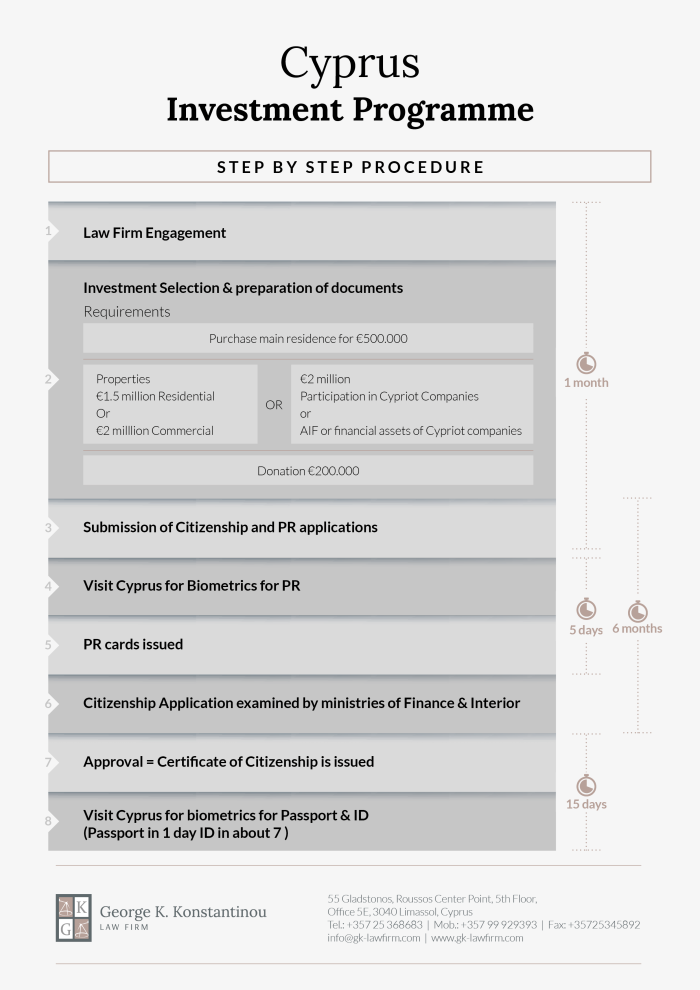
Key provisions and eligibility
- The family. The programme covered the applicant's spouse and children. Adult children in full-time education who depended on the applicant financially could be included up to an age limit that changed across versions of the scheme.
- The investor's parents were entitled to apply, provided they owned a Cyprus residential property valued at at least €500,000 plus VAT where it applied.
- Timing. The programme aimed to examine an application within six months.
- Duration. Citizenship granted under the programme did not expire and passed to children by descent. It could still be revoked, and some of it has been.
- Tax. A Cypriot passport carried no tax consequence on its own, then or now. Tax follows residence, and the rules are set out in the tax question in our FAQ below.
Terms and conditions
- Adult applicants had to hold clean criminal records from both their country of origin and their country of residence, where the two differed. Their names could not appear on the EU list of persons whose property is ordered to be frozen.
- An applicant whose citizenship application had been rejected by any other EU member state was not eligible.
- The applicant had to hold a valid Schengen visa. Third-country nationals who needed no entry visa to travel in EU member states, and EU citizens, were exempt.
- Adult applicants had to hold a residence permit in Cyprus for at least 6 months before acquiring citizenship.
- Investments had to be retained for at least 5 years from the date citizenship was acquired.
- The investor had to keep a residential house or apartment valued at €500,000 for life.
- Renting out any of the properties was allowed.
- The money for the investments had to be transferred to Cyprus from abroad.
The investment criteria
- The applicant had to buy a house or apartment in Cyprus for at least €500,000 plus VAT where it applied. The primary residence could not be sold, but it could be rented out.
- On top of that, one of the following investments was required:
| A1. Investment in real estate, land development, and infrastructure projects: | |||
| Residential properties €1.5 million (plus VAT, if any) (Could be a single primary residence for €2 million) |
OR | Commercial properties €2 million (plus VAT, if any) | |
| A2. Purchase, establishment, or participation in Cypriot companies or businesses |
for €2 million | ||
| A3. Investment in Alternative Investment Funds or financial assets of Cypriot companies or Cypriot organisations that CySEC licenses | |||
| A4. Combination of the investments mentioned above. | |||
Two donations were required on top of the investment:
- €100,000 to the Research and Innovation Foundation, or an investment of at least €100,000 in a certified innovative enterprise or social enterprise, or a donation of €100,000 to the Renewable Energy Sources and Energy Conservation Fund, the National Solidarity Fund, or the Service of Industry and Technology.
- €100,000 to the Cyprus Land Development Corporation.
The first of those two was lifted where the applicant had invested at least €400,000 under the criterion for purchase, establishment or participation in Cypriot companies. The company had to be active within the primary or secondary sector of the economy other than construction, or in research and development, education, health, or renewable energy sources.
Investment options explained
A1. Investment in real estate, land development, and infrastructure projects
The applicant had to have invested at least €2,000,000 in purchasing or constructing buildings, or in creating other land development projects, including residential or commercial developments, tourism sector developments, or other infrastructure projects.
Investment in land under development counted under this criterion, provided an investment plan for the development of the purchased area was included in the application. Investment in land in a zero-development building zone was excluded.
A2. Purchase, establishment, or participation in Cypriot companies or businesses
The applicant had to have purchased or participated in companies or organisations established and operating in the Republic of Cyprus, with at least €2,000,000 in investment costs. The invested funds had to be channelled towards financing the investment objectives of those companies exclusively in Cyprus, based on a specific investment plan.
Applications were evaluated to verify that the companies or organisations had a proven physical presence in Cyprus, with significant activity and turnover, and employed at least five Cypriots or citizens of EU member states. The minimum number of employees increased where more than one applicant invested simultaneously, or almost simultaneously, in the same business or company.
The employees of those companies had to have been legally and continuously residing in Cyprus for at least five years before the application submission date.
A3. Investment in Alternative Investment Funds or financial assets of Cypriot companies or Cypriot organisations that CySEC licenses
The applicant had to have bought units of at least €2 million from alternative investment funds established in the Republic of Cyprus, licensed and supervised by CySEC, whose investments were made exclusively in the Republic, in investments meeting the criteria of the programme or in areas approved by the Minister of Finance.
To confirm that qualifying investments would be retained for at least five years, the fund's manager or auditor had to inform the Ministries of Finance and Interior in writing, on an annual basis, of the initial investment value.
The purchase of financial assets of Cypriot companies or organisations of at least €2 million, such as bonds, bills and securities issued with the approval of CySEC, fell under this criterion. The issuing companies had to have a proven physical presence and substantial economic activity in the Republic, and the purpose had to be financing their investment plans exclusively in Cyprus, based on an investment plan.
The purchase by an alternative investment fund of units of other such funds was not eligible.
A4. Combination of the investments mentioned above
The applicant could proceed with a combination of the above investments, provided the total came to at least €2,000,000.
Application procedure
Registry of service providers
Applications could be filed on behalf of applicants only by persons entered on the Registry of Service Providers of the Cyprus Investment Programme, supervised by the Committee for Supervision and Control of Service Providers for the Cyprus Investment Programme.
Our firm holds registration number 110 on that register, first entered on 31 July 2018 and renewed on 17 January 2026.
Procedure and timeline
- The application was submitted to the Ministry of Interior. The applicant did not need to be present.
- The applications of the principal applicant, the spouse and the children were submitted at the same time.
- The Ministries of Interior and Finance examined the application for naturalisation and presented it to the Council of Ministers for approval.
- Once the application was approved and the applicant had held a permanent residence permit for at least six months, the citizenship process was complete.
- The Ministry of Interior issues the Certificate of Naturalisation on payment of the certificate issuing fee.
- The applicant then confirmed faith in the Republic of Cyprus before a Registrar of a Cypriot court or a consular officer.
- Biometrics were given in person so the passport could be issued, and the applicant applied for a Cyprus identity card at the local District Administration Office.
- Under the express passport procedure the passport is ready the same day where the application is approved before 12:00, and the next working day where it is approved later. Express passports are collected only at the Nicosia District Administration Office. The identity card takes about 15 working days.
The permanent residence condition
Before naturalisation as a Cypriot citizen, the applicant had to hold a permanent residence permit in Cyprus for 6 months.
That application could be submitted at the same time as the citizenship application, with no additional documents. Applicants had to be present in Cyprus to give their biometric data and signatures, and the Immigration Permit card was issued within five working days of collection.
Required documents
1. Curriculum Vitae for the investor, spouse & adult children.
2. Birth Certificate for the applicant, spouse & children (official and certified translation*).
3. Criminal Record Certificate for the investor, spouse & adult children from the country of origin and the country of residence, where different (official and certified translation*).
4. Marriage Certificate (official and certified translation*).
5. 2 passport-size photos for each family member.
6. Adult children: certificate of attendance by an academic institution (original).
7. Due Diligence Report issued through an internationally accepted database.
The documents marked (*) had to be translated into English and bear the «APOSTILLE» stamp, or be certified by the Ministry of Foreign Affairs of the issuing country, the Cyprus Embassy in that country, and the Ministry of Foreign Affairs in Cyprus.
Translation had to be done by the Press and Information Office, a Consular Authority, or a governmental department or service of the issuing country.
Other rules that applied
Investing through a company or a fund. Investment through a company, fund or foundation was eligible, provided a proven correlation existed between the investor and the company, fund or foundation.
Transfer fees. Property transfer fees did not count towards the investment amount, and neither did any other charge or tax.
The three-year and five-year rule. To file a naturalisation application under the scheme, the investor had to have concluded the investment in the three years before the submission date. An application made in 2019 needed an investment concluded between 2016 and 2019. The investor then had to retain the investment for at least five years after acquiring citizenship, counted from the date the Council of Ministers approved the application.
Programme fees
A Cypriot passport under the programme cost at least €2,000,000 in investment and €200,000 in donations. On top of that came government fees of €2,000 to submit and €5,000 to issue the certificate, for each adult in the application. Law 224(I)/2025 has since deleted the €2,000 submission fee from the Civil Registry Law.
Here are the details of the programme fees from before 2020.
| Applicant | CIP application submission fee | Certificate issuance fee | Total fees |
| Investor | €2,000 | €5,000 | €7,000 |
| Investor's spouse | €2,000 | €5,000 | €7,000 |
| Adult children & parents (each) | €2,000 | €5,000 | €7,000 |
| Minor child | €80 | €80 |
These two are current fees rather than 2020 fees.
| Passport, express issuance (each). The ordinary fee is €70 | €120 |
| Identity card, adult (each). A minor's card is €20 | €30 |
Our immigration lawyers would be happy to meet with you and talk through the routes that are open.
Frequently Asked Questions
Can you still buy Cyprus citizenship in 2026?
No. The Cyprus Investment Programme stopped accepting applications on 30 October 2020, and Law 224(I)/2025 repealed the section of the Civil Registry Law it ran under on 12 December 2025. No Cyprus scheme grants citizenship in exchange for an investment.
What is open is permanent residence by investment from €300,000, which is a residence permit, and naturalisation after years of living in Cyprus.
Will the Cyprus citizenship by investment programme come back?
Nothing suggests it. The 2020 closure was a policy decision. The December 2025 repeal removed the power itself from the statute, so reopening the programme would take a fresh Act of Parliament.
Parliament passed that repeal in co-operation with the European Commission to close an infringement case, which the Commission closed on 11 March 2026. The Court of Justice of the European Union has since ruled, in Case C-181/23 on 29 April 2025, that a scheme of this kind breaches EU law.
What replaced Cyprus citizenship by investment?
Permanent residence by investment, often called the Cyprus Golden Visa. You invest at least €300,000 in one of four forms: a first-sale home from a development company at €300,000 plus VAT, other real estate at €300,000, the share capital of a Cyprus company with premises and five employees, or units in a Cyprus collective investment fund.
You show a secured annual income of €50,000, rising by €15,000 for a spouse and €10,000 for each dependent minor child, and the money for the investment has to be shown to have come from abroad. The Migration Department examines the file in about two months.
It gives you the right to live in Cyprus. It is not a passport, and it carries no right to live or work in another EU country.
How much does Cyprus citizenship cost now?
There is no purchase price. What is left are government fees. Naturalisation on years of residence costs €500 to file form M127, with a further €5,000 where the accelerated eight-month examination is available. Registration by marriage costs €300 on form M125.
A Cyprus passport is €70 for an adult under the ordinary procedure and €120 express, and the identity card is €30. On the residence route the €300,000 is an investment that stays yours, with a €500 Immigration Permit fee covering everyone named in the application.
How long does it take to get Cyprus citizenship now?
On the general route, seven years of legal residence within the preceding ten, plus twelve months of continuous residence immediately before you apply. That is eight years in practice.
Highly skilled staff of companies named in the Council of Ministers decision of 15 October 2021 qualify sooner: four years within the preceding ten with Greek at A2, or three years with B1, in each case plus the final twelve months. Marriage to a Cypriot citizen takes three completed years, with residence conditions where the couple lives in Cyprus. Our guide to getting Cyprus citizenship covers each route.
Is it required to pass a Greek language proficiency test or exam in the history of Cyprus as a condition for obtaining citizenship of Cyprus?
Not under the investment programme. It is required on every route open today. An applicant naturalising on years of residence needs Greek at B1 and a pass of 60% or better in the state examination on the political and social life of Cyprus, in force since 19 December 2023.
Highly skilled staff of the companies named in the Council of Ministers decision of 15 October 2021 have shorter periods: four years within the preceding ten with Greek at A2, three years with B1, in each case plus the final twelve months.
Is the Cyprus passport a full EU passport, and does Cyprus allow dual citizenship?
Yes to both. Cyprus is a member state of the European Union, so a Cypriot passport is a full EU passport and its holder is a citizen of the Union, with the right to live and work in any member state. Cypriot law allows dual citizenship, so you keep the nationality you already hold.
Is North Cyprus citizenship by investment the same as Cyprus citizenship?
No. The Republic of Cyprus is an EU member state, and its citizenship is the one described on this page. The north is not the Republic, and nothing issued there carries EU citizenship or a Cypriot passport recognised by the Republic.
Our firm practises in the Republic of Cyprus and does not act in the north.
What tax burdens are imposed on an investor after obtaining Cypriot citizenship? Will the investor be required to pay taxes on income from sources located abroad?
A Cypriot passport carries no tax consequence on its own. Tax follows residence, not nationality.
You become a Cyprus tax resident by spending more than 183 days here in a calendar year. There is a second route, the 60-day rule: at least 60 days in Cyprus, no more than 183 days in any other single state, a permanent home here that you own or rent, and business, employment or a directorship in a Cyprus tax resident company.
Cyprus tax residents who are not domiciled here, meaning they have not been Cyprus tax residents for 17 of the last 20 years, pay no defence contribution on dividends or interest, in Cyprus or abroad. A domiciled resident pays 5% on dividends from 2026 profits and 17% on interest.
Rental income is different. Everyone pays income tax on it at the normal tax bands, after a 20% deduction for buildings. The defence contribution on rents ended on 31 December 2025.
Our pages on Cyprus tax residency and the non-domiciled rules and the Cyprus tax system and rates set out the detail.
Will my citizenship expire?
Citizenship does not expire and passes to children by descent. It can still be taken away.
Acting on the findings of the Nicolatos and Kalogirou inquiry committees, the Council of Ministers has revoked a number of citizenships granted under the programme. Law 224(I)/2025 kept that power in place when it repealed the power to grant new ones.
Which family members could be included in an investor's application?
The applicant's spouse and children. Adult children in full-time education who depended on the applicant financially could be included up to an age limit that changed across versions of the scheme.
The investor's parents could obtain citizenship separately by buying a Cyprus residential property for at least €500,000. They did not have to make the full €2 million investment. Neither the spouse nor the children had to invest anything.
Was there a residence requirement before citizenship was granted?
Yes, and it is often misreported. An adult applicant had to hold a Cyprus permanent residence permit for at least 6 months before acquiring citizenship, and had to come to Cyprus in person to give biometric data and a signature for that permit.
What the programme did not require was actually living here. There was no minimum number of days in the country before or after the grant, and no obligation to reside in Cyprus to maintain citizenship afterwards.
Did the investor have to buy a home as well, and did VAT count towards the amounts?
Yes, a home was required. Whichever criterion the investor applied under, the law required the purchase of a property for private use worth at least €500,000 before VAT.
An investor who had bought a single residential property worth €2 million did not need to buy anything further, and the same held for several residential properties adding up to that amount. VAT was counted towards neither the investment amount nor the €500,000, and where the market value and the purchase value differed, the purchase value was the figure that counted.
Could the investment and the home be sold afterwards?
The investment could be sold five years after purchase, and nothing was lost by selling it then. Within the first five years, a sale was possible only where the €2 million investment was maintained, so the investor had to buy a replacement home for €2 million, or several residential units totalling €2 million, at the same time. Where several units were bought, at least one had to be worth €500,000 or more.
The privately owned residence was treated differently. It could be rented out, since the investor was not required to live in Cyprus, and it could be sold and replaced by a different residence of equal or higher purchase value. After the five years, the investor had to keep one house or apartment bought for at least €500,000 in their own name.
Did resale properties count, or only new ones?
Both counted. Under the Council of Ministers decision, eligible investment was not limited to properties bought for the first time, so an investor could buy resale or new.
The difference was tax. A new property is subject to VAT at 5% or 19%, which is non-refundable and is never counted as part of the investment. Our guide to VAT on property in Cyprus explains when the reduced rate applies.