
Cyprus residency by investment
Updated:
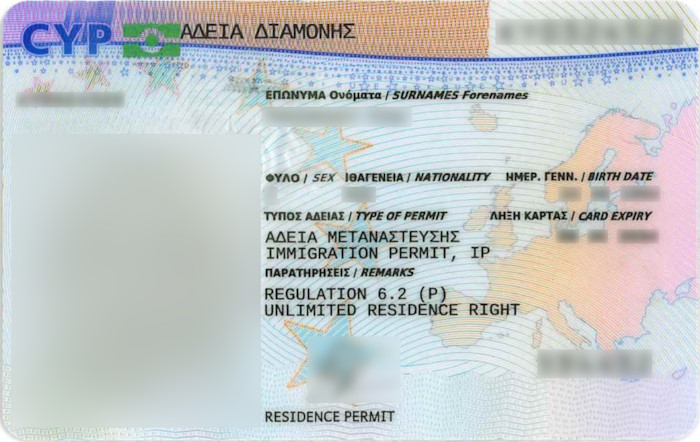
The Cyprus Residency by Investment program gives successful applicants and their families an unlimited-duration Cyprus immigration permit. The Migration Department sets the examination period at roughly two months from the date a complete application is submitted. In practice, it takes about six months.
It is the permit most people call the Cyprus golden visa. Investors with this permit can apply for Cyprus citizenship after 8 years of residency.
In 2026, applicants can obtain permanent residency in Cyprus by investing at least €300,000 and showing a secured annual income of at least €50,000. The investment can be in a new home from a developer, other real estate, new share capital of a Cyprus company, or units of a Cyprus investment fund.
The requirements in brief:
- An investment of at least €300,000, excluding VAT, in one of four categories.
- A personal secured income of at least €50,000 a year, measured before tax.
- An examination of about two months by the Migration Department's estimate, and about six months in practice.
- An application fee of €500, plus €70 per person for the ARC card where needed.
Changes announced in September 2026
On 24 September 2026, the Deputy Minister of Migration and International Protection told the House Audit Committee that decisions on tightening the investor permit scheme are expected. About 12,000 permits issued since 2013 are under review to check that their holders still meet the conditions. No new rules have been published. Until they are, the criteria on this page apply.
Short answers to four common questions
These short answers cover work, travel, tax and the passport.
- Can I work in Cyprus? The policy is for investors who do not plan to work. The investor and the spouse confirm in an official statement that they do not intend to take up any employment in Cyprus, apart from employment as a director of the company they invested in under the policy.
- Can I travel in the Schengen area on this permit? Not on the permit. Cyprus takes part in Schengen cooperation, but its internal border controls have not been abolished yet, and a Cyprus residence permit is not valid for travel to Schengen countries.
- Does it make me a Cyprus tax resident? Not by itself. Tax residency turns on where you spend your time under the 183-day and 60-day rules, set out in Cyprus tax residency and non-dom rules.
- Does it lead to a passport? Not directly. After eight years of legal residence, you can apply for naturalisation, with Greek at B1 and a civics examination, as set out in how to get Cyprus citizenship.
Contents ˅
Cyprus residency by investment requirements in 2026
To qualify in 2026, an applicant must invest at least €300,000 in one of four categories and show a secured annual income of at least €50,000, plus €15,000 for a spouse and €10,000 for each dependent child under 18. Where the income may come from depends on the category.
The four investment categories
The applicant invests in one of these four categories:
- Buy a new house or apartment from a developer.
A house or apartment bought from a development company as a first sale, for at least €300,000 plus VAT. Up to two housing units can count toward the total, from one development company or from two. A couple buying together meets the same total: at least €300,000 plus VAT for one or two properties.
The title deed or the sale contract is in the name of the applicant and/or the spouse and is filed with the Department of Lands and Surveys. Official payment receipts reach at least €300,000 excluding VAT, regardless of the delivery date, so off-plan properties count. A resale counts only where its sale contract was filed with the Department of Lands and Surveys before 7 May 2013.
- Purchase commercial properties.
Offices, shops, hotels or similar developments, or a combination of these, with a total value of €300,000. These purchases can be resales.
- Invest in new share capital of a Cyprus company.
An investment of €300,000 in the share capital of a newly registered Cyprus company, or an increase of €300,000 in the share capital of an existing Cyprus company. The company must be registered in Cyprus, be based and operating there, have a proven physical presence there and employ at least five people.
- Invest in units of a Cyprus collective investment organisation (AIF, AIFLNP or RAIF)
An investment of €300,000 in units of a Cyprus collective investment organisation, whose investments must be held in Cyprus.
We recommend that our clients opt for real estate as a safer, more secure investment option for obtaining Cyprus residency.
Income requirement
The applicant must show a personal secured annual income of at least €50,000. The Migration Department measures that figure gross, before tax, and has confirmed this to us in writing.
The amount rises by €15,000 for the spouse and by €10,000 for each dependent child under 18 of the applicant or the spouse. The spouse's income, if any, can count towards the total.
The income may include any of the following:
- salaries or wages,
- pensions, dividends, fixed deposits, and rental income
On the route of a new house or apartment, the income must come from abroad. On the other three routes, part or all of it may come from activities in Cyprus, if it is taxed in Cyprus.
On every route, the income is proved by a tax return from the country where the applicant is tax resident, or by official certificates from an independent certified accountant.
Annual obligations to verify criteria
There are verification requirements for investment residency.
Every year (annually), you should submit the following:
- Evidence that you maintain the investment, and
- A health insurance certificate for yourself and your family (if you are not GESY beneficiaries).
Every three years, you should submit the following:
- A clean criminal record certificate for yourself and your adult family members, from your country of origin and your country of residence.
The requirement to submit annual proof of your income level has been abolished.
You lose the permit if you:
- Acquire permanent residence abroad, or
- Leave Cyprus for two years.
Missed filings put the permit at risk
If you do not provide the annual and triennial evidence, the procedure to cancel the investor's and family members' permits begins.
What it costs in total
The investment is €300,000 before VAT. A new home carries VAT at 19%, or the reduced 5% rate on the first 130 m² of buildable area and the first €350,000.
The reduced rate needs a buyer aged 18 or over who buys the home as a main and permanent residence in Cyprus, holds no other home bought at that rate, and keeps the whole transaction within €475,000 and 190 m².
A buyer who stops living there within ten years must notify the Tax Commissioner within 30 days and pay the VAT difference for the period the home is not lived in. This does not apply on the buyer's death or on a transfer to an adult child who qualifies for the rate.
Government and legal fees
The government charges €500 for the application and €70 for the ARC card of each person who does not already have one. Our due diligence and legal support fee is €3,000 for a single applicant and €3,500 for a family.
Two worked examples
Both examples assume a new house or apartment bought from a developer for €300,000 before VAT, at the standard 19% rate. A first sale that carries VAT pays no Land Registry transfer fees, and no stamp duty is payable on a contract signed on or after 1 January 2026.
A single applicant:
- Property: €300,000, plus VAT of €57,000.
- Application fee: €500.
- ARC card: €70.
- Our due diligence and legal support: €3,000.
Total: €360,570.
A family of four, a couple with two children under 18:
- Property: €300,000, plus VAT of €57,000.
- Application fee: €500, covering the whole family.
- ARC cards: €280, at €70 for each of the four.
- Our due diligence and legal support: €3,500.
Total: €361,280.
If the home becomes the buyer's permanent residence and meets the limits above, the VAT on a €300,000 home of up to 130 m² falls to €15,000, which takes €42,000 off each total. These examples exclude document translation and health insurance. Our property lawyers handle the purchase itself.
Dependent persons
The immigration permit issued to the investor covers these people as dependants:
- Spouses and children under 18. A child's permit is valid until the child turns 18.
Each spouse can hold their own permit on a separate application with its own fee, and the second spouse does not have to meet the criteria. If the investor's permit is cancelled, the procedure to cancel the spouse's permit starts too.
Children aged 18 to 25
Unmarried children aged 18 to 25 are not covered by the parent's permit. They file their own application and pay their own fee. On the date of submission, they must be financially dependent on the applicant and enrolled in tertiary education abroad, and the parent must show an extra €10,000 in annual income for each of them.
A permit granted to such a child stays valid after they turn 25, after they marry, after they finish studying and after they stop depending on their parents. Their own spouse and minor children cannot be added to it as dependants, and the procedure to cancel it starts if the investor's permit is cancelled.
Children who want to study at a university in Cyprus apply first, through the institution, for a temporary residence permit as students. After their studies, they can file their own application for an Immigration Permit and pay the fee, regardless of age, if the parents show an extra annual income of €10,000 for each such child.
If the investment property does not have enough bedrooms for the applicant's dependent family members, the applicant must provide proof of another residence (such as a title deed, contract of sale or rental document) for those individuals.
Higher investment for adult children
The "adult children" are the applicant's children over 18 who are not financially dependent on the applicant.
For a non-financially dependent adult child to apply under the same investment, the applicant must meet the higher-value investment criteria. The investment rises by €300,000 for each adult child who relies on it.
Example investment calculations:
- Example 1: An applicant with one adult child must invest €600,000.
- Example 2: An applicant with two adult children must invest €900,000.
Where the investment is property, proof that at least 66% of its market value has been paid is submitted with the application. The investment can be in the joint names of the applicant and the adult child, or in the applicant's name alone.
Each adult child must show a secured annual income of at least €50,000 of their own, plus €15,000 more for a spouse and €10,000 more for each dependent child under 18. Each adult child files their own application and pays €500, plus €70 if they need an Alien Registration Certificate.
Does the permit lead to Cyprus citizenship?
Yes, through Cyprus citizenship by naturalisation, after eight years of legal residence in total. Investors have no shorter route.
Since 19 December 2023, an adult applicant must meet all of these conditions:
- legal and continuous residence for the 12 months right before the application, where absences of up to 90 days in total do not break that period;
- legal residence adding up to at least seven years in the 10 years before those 12 months;
- good character;
- Greek at level B1;
- a pass, with a grade of at least 60%, in the examination on the basic elements of the contemporary political and social reality of Cyprus;
- suitable accommodation and stable and regular income, enough for the applicant and the family;
- an intention to live in Cyprus.
Time spent in Cyprus on a student permit does not count towards these residence periods.
Holders of a diploma from a recognised Greek-medium secondary school, and holders of a degree from a programme taught in Greek, do not need the B1 certificate.
The shorter route for highly skilled staff
The law sets shorter periods for highly skilled employees of companies covered by the Council of Ministers decision of 15 October 2021, and for their family members. The employee must have at least two years with the company before applying.
For these employees, the 10-year window requires four years of legal residence with Greek at A2, or three years with B1, plus the final 12 months: five or four years in total. An investment permit does not make you one of them.
A holder who lives in Cyprus can apply for long-term resident status after five years, a separate EU status with its own tests. Cyprus residency vs citizenship sets out what each status gives you.
Benefits of investment PR
Cyprus permanent residency provides the following benefits:
- Unrestricted entry and stay within Cyprus.
- A corporate tax rate of 15% from 1 January 2026, with the non-domicile rules available to shareholders who become Cyprus tax residents. A permanent residence permit does not by itself make you a Cyprus tax resident, so your personal tax position turns on where you actually live and on the 183-day and 60-day rules.
- Inclusion of the applicant's spouse and minor children.
- Access to the General Healthcare System once you are an ordinary resident of the government-controlled areas. An investor who keeps a main home abroad stays outside GESY and needs private health cover.
- No minimum number of days in Cyprus each year. An absence of two years or more, or permanent residence in another country, ends the permit.
Schengen Area or Europe visa-free travel
Cyprus takes part in Schengen cooperation, but internal border controls have not been abolished yet, and its integration into the Schengen area is underway. Today, a Cyprus residence permit is not valid for visa-free travel to Schengen countries.
Additional information
These points cover keeping the permit, work, the investment funds, and the application itself.
- The permit ceases to be valid if the holder stays outside Cyprus for at least two years, or acquires permanent residence in another country. A visit to Cyprus restarts that count.
- The permit stops being valid if the holder and dependants live outside Cyprus and fail to take up residence there within one year of being notified of the approval.
- The applicant and the spouse confirm in an official statement that they do not intend to take up any employment in Cyprus. The exception is employment as a director of a company they invested in under the policy.
- Where the investment is not in a company's share capital, the applicant and the spouse may hold shares in Cyprus companies and receive dividends from them, and may sit on their boards as unpaid directors.
The money and the application
This part covers where the investment money comes from, how long the examination takes, the fees and who decides.
- The money for the investment must be shown to have come from abroad. It can come from the applicant's or spouse's bank account (if the spouse is included in the application), or from a company owned only by the applicant and/or the spouse (if that owner is included in the application). It is paid into the seller's account at a Cyprus financial institution, and it cannot come from borrowing in Cyprus.
- Our guide to opening a bank account in Cyprus covers the banking side.
- The Migration Department estimates the examination period at about two months from the date a complete application is submitted. In practice, it takes about six months, so plan on that figure.
- The application fee is €500. A further €70 is charged for each person included in the application who does not already hold an Alien Registration Certificate.
- The Deputy Minister of Migration and International Protection takes the final decision.
When a different permit fits better
This route is for non-EU investors who want permanent residence and do not plan to work in Cyprus. Other routes suit other readers, and Cyprus permanent residency sets them side by side.
- EU citizens do not use this route at all and register for a yellow slip instead.
- Readers with a steady income from abroad who do not invest €300,000 can look at the Category F immigration permit, which is based on that income.
- Readers who want a job in Cyprus should seek advice on the work permit rules before choosing this route, since investors confirm that they do not intend to take up employment, apart from a directorship in the company they invested in.
- Readers who already have a passport need the naturalisation route in how to get Cyprus citizenship. Citizenship by investment closed in 2020.
How the application runs
The purchase comes first, followed by the permit application. Our guide on buying a house in Cyprus and getting residency covers the purchase from reservation to the transfer of funds from abroad.
- Book an appointment with the Migration Department, or file through an authorised representative.
- Submit form MIP2 with the documents listed below and pay the €500 fee.
- Allow for the examination: about two months by the department's estimate, about six months in practice. The Deputy Minister of Migration and International Protection makes the decision.
- Provide biometric data (photo and fingerprints) for the residence card, at the time of the application or later, at the Migration Department in Nicosia or at the district unit of the Aliens and Immigration Service of the Police. If you live abroad, come to Cyprus to settle within one year of the date you are notified of the approval.
Required documents
The application goes in with the documents on the Migration Department's checklist:
- Application form MIP2, duly completed, from the Migration Department's forms page.
- Copy of the valid passport of the applicant and of each dependant.
- CV for the applicants.
- Marriage Certificate (official and certified translation*).
- Children's Birth Certificates (official and certified translation*).
- Criminal Record Certificate for the applicants from the country of origin and, where different, the country of residence (official and certified translation*).
- Official statements by the applicant and the spouse that they do not intend to take up any employment in Cyprus, apart from employment as a director of the company they invested in.
- A tax return from the country where the applicant is tax resident, or official certificates from an independent certified accountant, to prove the income. Submit the originals with an affidavit or an official statement of annual income.
This income may include salaries, pensions, dividends, fixed deposits, and rents. The spouse's income (if any) can be included.
- Documents proving that the amount used for the investment was transferred to Cyprus from abroad (e.g., by bank transfer).
- Evidence of where the family will live in Cyprus, such as a title deed, a contract of sale with proof of payment, or a rental agreement, on routes other than a new house or apartment. The same applies if the home has too few bedrooms for the family.
- Health insurance certificate for medical care covering inpatient and outpatient care, for the applicant and the family members.
- Representative's authorisation, signed and certified.
- If children between the ages of 18 and 25 apply, they will need a University confirmation and a list of other documents, which can be accessed at Immigration Permits for Investors - gov.cy.
Translation and certification
All documents must be in Greek or English, or include an official translation by a sworn translator or a consular or government authority in the issuing country.
Public documents from countries in the Hague Apostille Convention carry an Apostille. Public documents from other countries need diplomatic certification, a chain that starts at the issuing country's Ministry of Foreign Affairs and ends at the Cyprus Ministry of Foreign Affairs. Documents issued in Russia or Serbia need no certification if they are signed and carry the official seal of the issuing authority.
Investment-related documents
The investment-related documents required for your application depend on the investment route.
- Investment in a house/apartment or commercial properties: The title deed or the contract of sale filed with the Department of Lands and Surveys, official receipts for at least €300,000 excluding VAT, and a recent Search Certificate of Immovable Property from the Department of Lands and Surveys where the contract was signed or the title deed issued more than a year before the application.
- Investment in a Cyprus Company's share capital: Proof of payment, the Shareholders Certificate and Certificate of Incorporation from the Registrar of Companies, a business profile of the company, and Social Insurance Services evidence of the staff it employs. The department's checklist also lists a share purchase agreement of at least €300,000.
- Investment in units of a Cyprus Investment Organisation (AIF, AIFLNP, RAIF): Titles or other proof of the purchased units, proof of payment, CySEC confirmation on the setup of the fund, and the memorandum of the fund.
Frequently asked questions
How to get a permanent residence permit in Cyprus?
To obtain permanent residency by investment in Cyprus, you must invest at least €300,000 in a new home from a developer, in other real estate, in new share capital of a Cyprus company or in units of a Cyprus investment fund. You must show a secured annual income of at least €50,000, and you and your spouse provide clean criminal record certificates from your country of origin and, if different, your country of residence.
The required income rises by €15,000 for a spouse and €10,000 for each dependent child under 18. You and your family members submit a health insurance certificate for inpatient and outpatient care.
Is the €50,000 income before or after tax?
Before tax. The Migration Department measures the €50,000 gross and has confirmed this to us in writing. The published criteria do not say either way, which is why applicants ask.
The spouse's income counts toward the total, and the figure rises by €15,000 for a spouse and €10,000 for each child under 18.
Can the investor's family members be included in the application and get Cyprus PR by investment?
Yes, the investor's spouse and children under 18 can be included in the application for residency by investment and will accompany the applicant investor to Cyprus.
Can investments be returned after I get a permanent residency?
The investment stays yours, and the permit depends on keeping it. Each year you give the Migration Department evidence that you maintain the investment. Selling or otherwise disposing of it without an immediate replacement of equal or greater value starts the procedure to cancel the permit.
What are the rules for Cyprus residency by property investment in 2026?
The criteria in force in 2026, the fourth revision of May 2023, set a minimum investment of €300,000 and an annual income of at least €50,000. Each year the investor gives evidence of maintaining the investment and, if the family no longer benefits from GESY, of holding health insurance.
Every three years the investor and the adult family members give clean criminal record certificates. If this evidence is not given, the procedure to cancel the permits of the investor and the family starts.
The permit does not expire, but the permit card needs to be renewed every 10 years. Absences from Cyprus should not exceed two years.
Is it possible to get Cyprus residency by buying a property?
Yes. You can obtain Cyprus permanent residency by buying a house or apartment from a development company as a first sale, for at least €300,000 plus VAT, or by buying other real estate, such as offices or hotels, totalling at least €300,000. The other real estate can be a resale.
How long does the Cyprus investment permit take?
The Migration Department estimates the examination period at about two months from the date a complete application is submitted. In practice it takes about six months.
The Deputy Minister of Migration and International Protection takes the decision.
Do I have to live in Cyprus to keep permanent residency?
No. The permit sets no minimum number of days in Cyprus each year. It ends if you stay outside Cyprus for a period of at least two years, or if you acquire permanent residence in another country. A visit to Cyprus restarts that count.
There is one earlier deadline. If you and your family live outside Cyprus, you must come to Cyprus to settle within one year of the date you are notified of the approval, or the permit stops being valid.
Keeping the permit and qualifying for citizenship are different tests. Naturalisation needs years of actual legal residence, which occasional visits do not give you.
Does Cyprus permanent residency give access to the Schengen area?
No. Cyprus takes part in Schengen cooperation, but internal border controls have not been abolished yet, and a Cyprus residence permit is not valid for travel to Schengen countries. See Cyprus and the Schengen Area and travel with a Cyprus residence permit.
Can I work in Cyprus with a permanent residence permit obtained through investment?
The policy is for investors who do not intend to work in Cyprus. You and your spouse confirm in an official statement that you do not intend to take up any employment there, with one exception: employment as a director of the company you invested in under the policy.
Where your investment is not in a company's share capital, you may hold shares in Cyprus companies and receive dividends from them, and you may sit on their boards as unpaid directors.
Does the permit make me a Cyprus tax resident?
No. Tax residency depends on where you spend your time, not on your permit. You are a Cyprus tax resident if you spend more than 183 days in Cyprus in the tax year.
The 60-day rule covers a person who spends at least 60 days in Cyprus in the tax year and no more than 183 days in any other single country. The person must keep a permanent home in Cyprus, owned or rented.
At some point in the year the person must carry on a business or be employed in Cyprus, or hold an office (a directorship, for example) in a person that is tax resident in Cyprus. The test fails if that tie ends during the year. See Cyprus tax residency and non-dom rules.
What happens if I sell the investment property?
Selling or otherwise disposing of the investment starts the procedure to cancel the permit. The exception is an immediate replacement with another investment of equal or greater value that meets the same conditions. The same rule applies to a share capital investment and to fund units.
If the investor's permit is cancelled for any reason, the procedure to cancel the spouse's own permit starts too, and so does the procedure for any child who holds a separate permit through the student route, whatever the child's age.