
Yellow Slip in Cyprus
Updated:
The Cyprus Yellow Slip is the registration certificate for EU, EEA and Swiss citizens and for their family members who are themselves EU, EEA or Swiss citizens. It records the holder's registration with the Cypriot authorities. EU citizens and their family members have free access to employment, including employed and self-employed activity.
An EU citizen with a valid identity card or passport can stay in Cyprus for up to three months without registering. To stay longer, they apply for the Yellow Slip on form MEU1 within four months of arrival.
Contents ˅
- How to get a yellow slip in Cyprus?
- The four MEU documents compared
- MEU1, registration certificate for EU citizens in Cyprus
- MEU2, residence card for non-EU family members in Cyprus
- MEU3, permanent residence for EU, EEA and Swiss citizens and their family members
- What are the yellow slip benefits?
- Cyprus yellow slip validity
- How to renew a yellow slip in Cyprus?
- What a yellow slip does not give you
- Cyprus yellow slip and Brexit
- Frequently asked questions
How to get a yellow slip in Cyprus?
To get a Yellow Slip, file form MEU1 with the documents listed in this section and pay the €20 fee.
Applicants show that they work or are self-employed in Cyprus (or have kept worker status), that they are enrolled at an institution approved or funded by the Republic mainly to study, including vocational training, with full sickness insurance in Cyprus and a declaration of sufficient resources, that they have sufficient resources for themselves and their family and full sickness insurance in Cyprus, or that they are the family member accompanying or joining an EU citizen who meets one of these.
Kept worker status
Kept worker status means a person who has stopped working keeps the rights of a worker during a temporary inability to work through illness or accident, or during vocational training, which must relate to the previous work, except where the person lost that work against their will.
A person registered with the Department of Labour as involuntarily unemployed and seeking work keeps worker status too, after more than a year of work, or for at least six months after a shorter job or a fixed-term contract of under a year.
The family of a student
For a student, the family rule is narrower than the general one: only the spouse and dependent children have the right to join, so a child under 21 who is not dependent is not covered. Dependent parents and grandparents of a student or of the student's spouse do not have this right; their entry and residence are only made easier under the Aliens and Immigration Law.
Registration for EU pensioners
EU pensioners register on the same MEU1 form, on proof of sufficient resources rather than employment. Our guides to moving to Cyprus and retiring to Cyprus cover what comes after the registration.
What happens if you miss the four-month deadline
Failing to apply for the registration certificate within the four months is an offence with a fine of up to €2,500 under Law 7(I)/2007. The same applies to a family member from outside the EU who does not apply for the residence card.
If you are already past the four months, speak to our Cyprus immigration lawyers before you file.
Required documents
The documents required for the registration include:
- Application forms MEU1 or MEU2, duly completed
- Copy of a valid passport, or an identity card for an EU citizen (bring the original when you submit)
- Marriage or civil partnership certificate, duly certified and translated if issued abroad, with the original * (If applicable)
- Children's Birth Certificates, duly certified and translated * (If applicable)
- Original court decision on parental responsibility, or the other parent's sworn consent to the child's stay or residence in Cyprus and its proposed duration, from a competent authority of the child's country, duly certified and translated * (for a minor child)
- Title deed or rental document for the address where you live
The rental document
The signatures of landlord and tenant on a rental document are certified by a certifying officer, and you bring the original rent payment receipts. The rental document shows the names of the owner and the tenants, their ID or ARC numbers and contact numbers. For an MEU1, it states the address that will be your official postal and contact address with the Department.
Bring the original utility bills your list names, such as electricity and water, in the tenant's name or, where the list asks for it, in the name of one of the spouses.
Stamp duty after the 2026 repeal
For a rental document signed on or after 1 January 2026, no stamp duty is payable. For a rental document that any party signed before 2026, the old stamp duty still applies: it is paid to the Tax Department within 30 days of signing, with surcharges after that.
A rental document signed in Cyprus before 2026 and never stamped is now more than six months late, so the duty is paid with a fine of twice the surcharge, before you file.
The Department's document lists still say "duly stamped". That wording no longer applies to a document that every party signed on or after 1 January 2026, because stamp duty was abolished from that date.
Proof of income and health insurance
Bring the documents that match your situation:
- If you are not working in Cyprus, evidence of stable or satisfactory income, such as a pension, dividends, rent, interest or earnings from work abroad, or of sufficient deposits in a bank in Cyprus or abroad, with bank account activity for the last quarter.
- If they are working in Cyprus:
a. Confirmation letter from the employer
b. Part III of the application form, on employment data, signed and bearing the employer's company stamp, with a salary certificate where applicable
c. Certificate of registration with the Social Insurance Services and a detailed statement of contributions stating the last employer and salary
d. For a self-employed person, a certificate of payment of contributions to the Social Insurance Fund for the last four months - Health insurance (not needed for the MEU1 if working in Cyprus and registered with the Social Insurance Services)
An applicant who registers on sufficient resources or as a student has to show full sickness insurance cover in Cyprus. For both groups, the law makes it a condition of the right of residence beyond three months.
Bring Plan A health insurance, which covers medical care, inpatient and outpatient care and the cost of transporting the body in case of death, or a GeSY registration certificate with body transport cover. A pensioner can bring form S1 (E121) instead, and a student a European Health Insurance Card. An EU citizen who pays social insurance in another European country brings form A1 and Plan A health insurance.
For an MEU2 application, bring Plan A cover, or a GeSY registration certificate with body transport cover, in every case, including when the EU citizen works in Cyprus.
Photographs and document certification
Passport photos are unnecessary as they will be taken at the relevant office when you apply.
A document marked (*) that is not in Greek or English needs an official translation from a sworn translator, or from a consular authority or a government department of the issuing country. A public document issued in a country that has ratified the Hague Apostille Convention of 5 October 1961 carries an Apostille.
A public document from any other country needs diplomatic certification, a chain that starts with the Ministry of Foreign Affairs of the issuing country and ends with the Ministry of Foreign Affairs of the Republic. A non-public document is certified by a certifying authority of the issuing country. Documents issued in Russia or Serbia need no certification if they are properly signed and bear the official seal of the issuing authority. The Department's document ratification page sets out each step.
EU documents without an Apostille
Under EU Regulation 2016/1191, certain public documents issued by the authorities of one EU Member State and submitted to the authorities of another need no Apostille or other authentication. The list includes documents on birth, death, marriage, divorce and registered partnership.
For some of these documents a multilingual standard form is available. Attached to the document, it removes the need for an official translation. Not every Member State issues the form for every document.
The complete list of documents for the MEU1 form can be downloaded at Registration of EU citizens - gov.cy
For the MEU2 form, follow the link at EU/EEA Citizens And Family Members - gov.cy
Application procedure
In the Nicosia district the applicant goes to the Migration Department and needs no appointment. In every other district the applicant or their lawyer arranges the appointment by email with the District Unit of the Aliens and Immigration Service of the Police, using the contact details below. Book early, so that the appointment falls well inside the four-month window.
The applicant attends in person. An EU citizen gives a photograph for the MEU1. A family member from outside the EU gives biometric data, meaning a photograph and fingerprints, and a signature for the MEU2 and for the MEU3 card. A child under six gives a photograph only.
Who can attend with the applicant
A lawyer can prepare the file and, as a duly authorised representative, deal with the Migration Department for the applicant.
For an MEU2 application the Migration Department requires the EU citizen to attend with the family member and to provide evidence of sufficient resources for themselves and for the family member. For an MEU3 application from a family member from outside the EU, the Department requires the EU citizen to attend with the family member.
Cyprus government fees
A fee of €20 is paid for each person who applies, the EU citizen and every family member alike. The fee is the same for the MEU1 certificate, the MEU2 card, and both MEU3 documents: the permanent residence certificate and the permanent residence card.
Application submission location
Applications go to the Central Offices of the Migration Department for the Nicosia district and to the District Unit of the Aliens and Immigration Service of the Cyprus Police for the other districts. The Migration Department of the Deputy Ministry of Migration and International Protection issues the decision.
The applicant applies in the district where they live: outside the Nicosia district, that is the District Unit of the Aliens and Immigration Service of the Police for that district. A person from another district can use the Nicosia office only through a duly authorised representative whose professional office is in Nicosia.
Office addresses and opening hours
In the Nicosia district, you deal with the Migration Department directly, at 90 Archbishop Makarios III Avenue, 1077 Nicosia, on 22308808. The office is open Monday to Friday from 08:00 to 14:30, with last entry at 14:00, except on public holidays.
Contact details for the other districts:
| District | | Telephone |
| Limassol | 25805650, 25805210 | |
| Larnaca | 24804236, 24804238 | |
| Paphos | 26806222, 26806215 | |
| Famagusta | 23803286, 23803288 |
The District Units are open Monday to Friday from 07:30 to 14:30, with last entry at 13:30, except on public holidays. Limassol: 223 Franklin Roosevelt Avenue. Larnaca: Piale Pasha. Paphos: 22 Eleftheriou Venizelou Avenue, corner of Kaniggos Street, 2nd floor. Famagusta district: 31 Giorgou Papadopoulou, Paralimni.
How to check your application status
The Migration Department runs a one-off SMS service with no registration. Send an SMS to 1199 with the word STATUS, a space, and your application number, for example STATUS 1234/2026. Each message costs under €0.04.
The application number is on the receipt you were given when you paid the fee, form Γ.Λ. 301B. Keep that receipt. It is your proof of submission if the Police ask for it when the application is pending.
Travelling abroad with a pending application
A family member from outside the EU who travels abroad with a pending application needs more than the fee receipt. The Migration Department says the receipt must carry a Department stamp that allows re-entry.
Without that stamp, the family member applies to the Department for a re-entry permit, which is granted as a rule only for serious reasons such as health.
A valid residence card issued by Cyprus or another member state exempts a family member from outside the EU from the entry visa. With a pending application and no valid card yet, check the visa rules of the country you travel to before you go.
The four MEU documents compared
EU citizens get the MEU1 registration certificate and the MEU3 permanent residence certificate; family members from outside the EU get the MEU2 residence card and the MEU3 permanent residence card.
| Form | Who it is for | What you get | How long it lasts |
| MEU1 | EU, EEA and Swiss citizens, and family members who hold one of those citizenships themselves | Paper registration certificate | No expiry date |
| MEU2 | Family members from outside the EU | Plastic biometric residence card | Up to five years |
| MEU3 (EU citizens) | EU, EEA and Swiss citizens after five years | Permanent residence certificate | No validity period in law |
| MEU3 (third country family members) | Family members from outside the EU after five years | Permanent residence card | Ten years, renewable |
MEU1, registration certificate for EU citizens in Cyprus
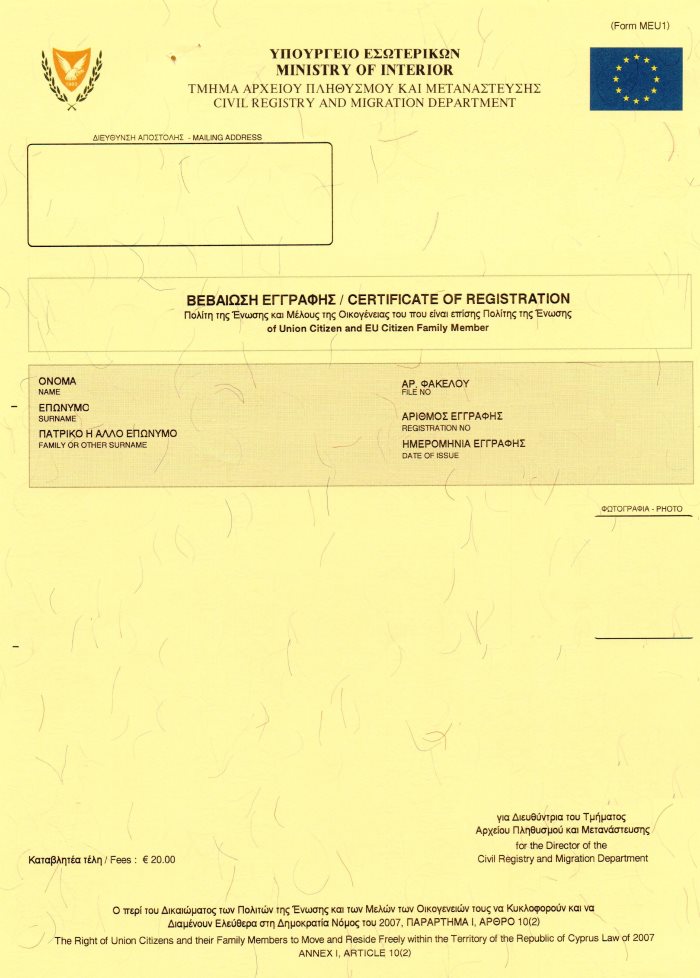
The MEU1 is a Registration Certificate for EU, EEA, and Swiss citizens and their family members who are Union citizens.
It is required for stays in Cyprus of more than 3 months and records their right to reside in Cyprus.
Download the MEU1 form from the Migration Department: MEU1 application form and supporting documents list.
The department revised every application form in March 2026. From 2 April 2026 it accepts only the revised versions, so take the file from the department's own page rather than from a copy stored anywhere else.
Processing time for MEU1
When the file is complete, the certificate is usually handed over on the day of application, at the office where the application was submitted. The law requires the registration certificate to be issued immediately, and the Migration Department's own outer limit for a decision is one month, provided the form is complete and every supporting document is there.
The certificate is given only to the applicant or to a duly authorised representative. A rejection letter, with the reasons, goes to the latest address the applicant declared, so keep that address current.
MEU2, residence card for non-EU family members in Cyprus
The MEU2 is the application form for a residence card for family members from outside the EU (for example a spouse or children) of citizens of other EU or EEA states or of Switzerland.
This card is needed for stays in Cyprus of more than 3 months.
Download the MEU2 form from the Migration Department: MEU2 application form and supporting documents list.
Who counts as a family member
Family member covers the spouse or a partner in a civil union, the children, grandchildren and other direct descendants of the EU citizen or of the spouse or partner who are under 21 or financially dependent, and the financially dependent parents, grandparents and other direct ancestors of the EU citizen or of the spouse or partner.
A child under 21 qualifies whether or not the child is dependent. A child of 21 or over qualifies on proof of dependence.
Processing time for MEU2
The Migration Department examines the MEU2 application and issues its decision within six months at the latest, provided the form is complete and every supporting document is there. A file with gaps in it falls outside that limit.
On approval the applicant is notified to collect the residence card.
MEU3, permanent residence for EU, EEA and Swiss citizens and their family members
The MEU3 is the application form for a Permanent Residence Certificate in Cyprus. It is for EU, EEA, and Swiss citizens, plus their EU family members, after five years of uninterrupted legal residence in Cyprus.
This certificate confirms their right to permanent stay, and the law sets no validity period for it.
There are two MEU3 forms. EU, EEA and Swiss citizens use the MEU3 form for EU citizens. Family members from outside the EU use the MEU3 form for third country family members.
The law sets no fixed period for an EU citizen's permanent residence certificate: it is issued as soon as possible after the application.
The Department's list for an EU citizen who works in Cyprus asks, among other documents, for:
- A copy of the MEU1 certificate
- The monthly Social Insurance contribution statement and the tax returns for the last five years
- Evidence of stable or satisfactory income for the last five years, with bank account activity for the last quarter
- Electricity and water accounts in the applicant's name for the last five years
- The title deed or rental document
MEU3 for family members from outside the EU
A family member from outside the EU who has lived in Cyprus lawfully with the EU citizen for five uninterrupted years applies on the MEU3 form for third country family members. The document issued is a permanent residence card valid for ten years and renewed as of right on application and a €20 fee.
The Migration Department completes its examination and issues a decision within six months at the latest for MEU3 applications from family members from outside the EU, provided the form is complete and every supporting document is there.
Permanent residence for EU citizens after five years
Five uninterrupted years of lawful residence in Cyprus gives an EU, EEA or Swiss citizen the right of permanent residence.
Permanent residence is lost only through an absence of more than two consecutive years. A break in residence of up to two consecutive years does not affect the validity of the permanent residence card held by a family member from outside the EU.
Third country nationals who are not family members
Third country nationals who are not family members of an EU citizen follow a different route. See Cyprus permanent residency for the fast-track and Category F options, and long-term resident status after five years for the EU-wide status.
What are the yellow slip benefits?
Benefits of the Yellow Slip in Cyprus include:
- A right to live in Cyprus for as long as you meet the conditions of residence.
- Free access to employment, including employed and self-employed activity, which comes with the right of residence.
- If you are an EU citizen, or a family member of any nationality with a right of residence, living in the government-controlled areas of Cyprus under these rules, you get the same treatment as a Cypriot citizen in matters EU law covers, apart from exceptions EU law sets.
- The law makes two exceptions, and neither applies to workers, self-employed persons, people with kept worker status, or their family members: no right to social benefits in the first three months of residence (longer for a job seeker), and no maintenance aid for studies, including vocational training, in the form of grants or student loans, before permanent residence.
- The Yellow Slip alone does not give access to GeSY, the national health system. An EU citizen living in the government-controlled areas can use GeSY if any one of four applies: they are employed, they have permanent residence status, they are a family member of a GeSY beneficiary, or they are insured in another EU Member State.
Cyprus yellow slip validity
The Yellow Slip for European Union citizens does not expire. The residence card for family members from outside the EU is valid for five years from issue, or for the shorter period the EU citizen plans to stay.
Absences within set limits do not affect the residence card. Temporary absences of up to six months a year are allowed, as are longer absences for compulsory military service and one absence of up to twelve consecutive months for reasons such as pregnancy and childbirth, serious illness, study, vocational training or a posting abroad. Longer than that and the residence card ceases to be valid.
How to renew a yellow slip in Cyprus?
An EU citizen's Yellow Slip (MEU1) does not need renewing.
A family member from outside the EU whose residence card runs for less than five years must apply for a new card if still in Cyprus when it expires. Work to the Migration Department's date: at least one month before the card expires.
The law sets a later last day, one month after expiry. Missing that day is an offence with a fine of up to €2,500.
Permanent residence instead of renewal
A family member from outside the EU who reaches five uninterrupted years of lawful residence in Cyprus with the EU citizen applies for permanent residence on the MEU3 form for third country family members instead of renewing.
The permanent residence card has its own deadline in law: apply no later than one month after the residence card expires. Missing it is an offence with a fine of up to €2,500.
What a yellow slip does not give you
The yellow slip is a residence document, not a nationality. It does not make the holder a Cypriot citizen and it does not shorten the naturalisation period.
See how to get Cyprus citizenship for the routes and the qualifying years.
It is not the ARC number either. The ARC, or Alien Registration Certificate number, is the identifier Cyprus assigns to foreign residents, and it is a separate thing from the registration certificate.
A Cyprus residence document is not a Schengen visa, and the country-by-country position is set out in which countries you can visit with a Cyprus residence permit.
Cyprus yellow slip and Brexit
A UK citizen who arrives in Cyprus after the transition period ended, holds no EU, EEA or Swiss citizenship and has no Withdrawal Agreement rights cannot apply for a Yellow Slip/MEU1.
That person is a third country national and needs a residence permit to live in Cyprus, such as the Pink Slip or Category F. A UK citizen who is a family member of an EU, EEA or Swiss citizen other than a Cypriot applies on form MEU2 instead.
A UK national taking a job with a Cyprus company of foreign interest applies through the work permit route instead.
UK nationals who lived or worked in Cyprus under EU free movement rules before the transition period ended on 31 December 2020, and who still live or work here, keep their rights under the Withdrawal Agreement. Our guide to moving to Cyprus after Brexit sets out the options.
UK citizens who held a Yellow Slip before Brexit
UK citizens and their family members who had a Yellow Slip before Brexit remain unaffected. If they have resided in Cyprus for five or more years, they have the right to permanent residence.
They can optionally complete form UKW1 to replace their existing documents with the new residence document issued on or after January 1, 2021. The form UKW1 is filled out by UK nationals and their family members who are also UK nationals.
Family members who are not UK or EU citizens
Family members of a UK national who are not UK or EU citizens are in a different position. They may keep using their MEU2 residence card until it expires, and they are required to apply for the new residence document on form UKW2 under the Withdrawal Agreement.
Validity of UKW documents and fees
The residence document issued under UKW 1 & 2 is valid for 5 years. Then, UK nationals and their family members can apply for permanent residence using UKW3.
Each application for a UKW residence document costs €30 per person.
For more information, please visit the official website at UK citizens and family members - gov.cy.
Frequently asked questions
What does a yellow slip mean in Cyprus?
A yellow slip is the MEU1 registration certificate of an EU, EEA or Swiss citizen living in Cyprus. A stay beyond three months needs MEU1 registration. Family members from outside the EU apply for a residence card on form MEU2.
What is the Cyprus government fee for a yellow slip?
The government fee is €20 per person, and every member of the family pays their own. The same €20 applies to the MEU1 registration certificate for an EU citizen and to the MEU2 residence card for a family member from outside the EU. It is €20 again for the MEU3 permanent residence certificate or card after five years. Legal fees for handling the application are quoted separately.
How long does the Migration Department take to decide?
In practice, a complete Yellow Slip application usually gets its certificate the same day. The Department's limit for a Yellow Slip is one month, or six months for the MEU2 residence card or the permanent residence card of a family member from outside the EU, once the form is complete with every supporting document. An EU citizen's permanent residence certificate has no fixed limit: it is issued as soon as possible after the application.
What is the difference between the pink slip and the yellow slip?
The Yellow Slip is the registration certificate for EU, EEA and Swiss citizens and for their family members who hold one of those citizenships themselves. The family member's citizenship does not have to match the Union citizen's. A family member from outside the EU gets a residence card.
The Pink Slip is the visitor permit for third country nationals. The first permit is issued for one year and is renewable as long as the criteria are met, and it does not allow economic activity. The applicant shows foreign remittances in their own name into a Cyprus bank account of at least €24,000 a year for one person, with 20% more for a spouse and 15% more for each child.
How long can an EU citizen stay in Cyprus?
An EU citizen can stay up to three months on a valid identity card or passport alone. Longer stays need work, self-employment or kept worker status, enough money for yourself and your family and full sickness insurance, enrolment mainly to study at an approved or state-funded institution with full sickness insurance and a declaration of enough money, or being a qualifying EU citizen's family member.
What happens if I do not apply for a yellow slip within four months?
You risk a fine of up to €2,500. Not applying within four months of arrival is an offence for anyone staying over three months: the Yellow Slip for an EU citizen, the MEU2 residence card for a family member from outside the EU.
How do I check the status of my yellow slip application?
By SMS to 1199: type STATUS, a space and your application number. The number is on the fee receipt, form Γ.Λ. 301B. One message costs under €0.04.
Do I need an appointment to submit a yellow slip application?
In the Nicosia district, no. The Migration Department takes applications on a first-come, first-served basis, Monday to Friday from 08:00 to 14:30, with last entry at 14:00. Outside Nicosia, the applicant or their lawyer emails the District Unit of the Aliens and Immigration Service of the Police where the applicant lives to book an appointment. The unit replies within five working days.
Can I work during the examination of my yellow slip application?
Yes. The right to work comes with the right of residence, not with the certificate. Nobody can require the certificate before you start work if you can prove your right of residence another way, so an EU citizen working or self-employed in Cyprus does not wait for it to arrive. Family members of any nationality who have a right of residence have the same free access to work.
How long does a yellow slip last?
The MEU1 registration certificate for an EU, EEA or Swiss citizen has no expiry date. A family member from outside the EU holds an MEU2 residence card for five years from issue, or for the EU citizen's planned stay when that is under five years. After five years of continuous lawful residence with the EU citizen, the family member applies for a permanent residence card, valid for ten years and renewable.
Do children need a yellow slip?
Yes, an EU, EEA or Swiss child staying over three months registers on the MEU1, whatever the parent's grounds for residence. A child from outside the EU gets the MEU2 residence card if under 21 or dependent; a student's child must be dependent.
Can I travel to other EU countries with a yellow slip?
The MEU1 certificate is not a travel document: EU citizens travel on a valid identity card or passport. With a valid MEU2 residence card or another member state's equivalent, a family member from outside the EU needs no visa for Cyprus; check other states' rules.
What is the difference between the yellow slip and permanent residence?
The yellow slip records a right of residence that lasts only as long as you meet its conditions, such as work, or sufficient resources with sickness insurance. Permanent residence, applied for on the MEU3 form after five uninterrupted years, no longer carries those conditions.